Revista Electrónica Educare (Educare Electronic Journal) EISSN: 1409-4258 Vol. 29(1) ENERO-ABRIL, 2025
doi: https://doi.org/10.15359/ree.29-1.18524
https://www.revistas.una.ac.cr/index.php/educare
educare@una.ac.cr
[Cierre de edición el 30 de abril del 2025]
A Seminar on Music Research in Higher Education and the Flipped Classroom: An Action Research Project
Un seminario sobre investigación musical en la educación superior y el aula invertida: un proyecto de investigación-acción
Um seminário sobre pesquisa musical no ensino superior e sala de aula invertida: um projeto de pesquisa-ação

Raúl Wenceslao Capistrán-Gracia
Universidad Autónoma de Aguascalientes
 https://ror.org/03ec8vy26
Aguascalientes, México
raul.capistran@edu.uaa.mx
 https://orcid.org/0000-0002-4594-8570
Elissavet Perakaki
National and Kapodistrian University of Athens
https://ror.org/04gnjpq42
Athens, Greece
eperak@music.uoa.gr
https://orcid.org/0009-0007-2456-0319
Recibido • Received • Recebido: 08 / 06 / 2023
Corregido • Revised • Revisado: 28 / 02 / 2025
Aceptado • Accepted • Aprovado: 02 / 04 / 2025
Abstract:
Introduction. The compulsory Seminars on Music Research I and II in the Bachelor of Music program at the Autonomous University of Aguascalientes (UAA) aim to introduce students to the field of research. However, the methods instructors employed have not fully met expectations in terms of engaging students and promoting their active participation in class activities and assignments. Researchers implemented the Flipped Classroom (FC) to explore alternative pedagogical strategies and help students approach music research methods more effectively. Objective. This study aimed to examine the feasibility of implementing FC in the Music Research Seminar I and the benefits and challenges for both instructors and students. Methodology. The methodology used was action research. Data collection methods included a field diary, non-participant and participant observations, and feedback from a critical friend. An ad hoc survey was designed to evaluate the overall intervention and assess the achievement of the study’s objective. Results. The FC approach enabled students to develop a deeper understanding of research methods and tools in music, exchange ideas and questions, and foster a collaborative environment among students and the instructor. The most notable outcome was students’ perception that they could manage their time and work at their own pace. Conclusion. The FC pedagogical strategy proved to be an effective approach for fostering students’ interest in the class, developing their music research skills, and enhancing their metacognitive abilities. Finally, students need time to adapt to a new learning structure and estimate its benefits. Future research could explore the long-term impact of implementing FC and compare teaching approaches to adapt them to students’ learning needs.
Keywords: Music research course; flipped classroom approach; action research; students’ engagement; higher education; students’ motivation; digital educational material.
SDG: SDG 4; Quality education; academic success.
Resumen:
Introducción. Los Seminarios de Investigación Musical I y II en la Licenciatura en Música de la Universidad Autónoma de Aguascalientes (UAA) tienen como finalidad iniciar a estudiantes en el campo de la investigación; sin embargo, las estrategias implementadas por el personal docente para promover el interés de las personas estudiantes y fomentar su participación activa en clase no cumplieron totalmente con sus expectativas. El personal investigador implementó el enfoque del aula invertida o flipped classroom (FC) para encontrar formas alternativas de enseñar y ayudar a estudiantes a abordar los métodos de investigación musical de manera más efectiva. Objetivo. El objetivo principal de la investigación fue explorar la viabilidad de la implementación del enfoque FC en el Seminario de Investigación Musical, así como los beneficios y desafíos que implica tanto para las personas docentes como para la población estudiantil. Metodología. La metodología utilizada fue la investigación acción y los instrumentos de recolección de datos fueron el diario de campo, las observaciones no participantes y participantes, así como las observaciones y comentarios del amigo o amiga crítico. Para evaluar la intervención completa y el logro de sus objetivos, los sujetos investigadores diseñaron una encuesta ad hoc. Resultados. El enfoque del FC permitió al estudiantado comprender profundamente los métodos y las herramientas de investigación musical, intercambiar ideas y dudas y establecer un ambiente de cooperación entre la población estudiantil y el personal docente. El resultado más importante estuvo representado por las percepciones de las personas estudiantes, quienes sintieron que tenían la oportunidad de organizar su tiempo y trabajar a su propio ritmo. Conclusión. El enfoque FC demostró ser un enfoque beneficioso para promover el interés estudiantil en la clase, cultivar sus habilidades en la investigación musical y estimular su metacognición. Finalmente, esta población de estudiantes necesita tiempo para adaptarse a una nueva estructura de aprendizaje y estimar sus beneficios. Investigaciones futuras podrían explorar el impacto del enfoque FC a largo plazo, comparar distintos enfoques de enseñanza y adaptarlos a las necesidades de su aprendizaje.
Palabras claves: Curso de investigación musical; enfoque del aula invertida; investigación acción; compromiso de las personas estudiantes; educación superior; motivación estudiantil; material educativo digital.
ODS: ODS 4; Educación de calidad; éxito académico.
Resumo:
Introdução. Os Seminários de Pesquisa Musical I e II do Bacharelado em Música da Universidade Autônoma de Aguascalientes (UAA) têm como objetivo iniciar os alunos no campo da pesquisa; No entanto, as estratégias implementadas pelos professores para promover o interesse dos alunos e incentivar a sua participação ativa nas aulas não corresponderam plenamente às suas expectativas. Os pesquisadores implementaram a abordagem Flipped Classroom (FC) para encontrar formas alternativas de ensino e ajudar os alunos a abordarem os métodos de pesquisa musical de maneira mais eficaz. Objetivo. O principal objetivo da pesquisa foi explorar a viabilidade de implementar a abordagem FC no seminário de pesquisa musical, bem como os benefícios e desafios que isso implica para professores e alunos. Metodologia. A metodologia utilizada foi a pesquisa-ação e os principais instrumentos de coleta de dados foram o diário de campo, as observações não participantes e participantes, bem como as observações e comentários do amigo crítico. Para avaliar toda a intervenção e o alcance de seus objetivos, os pesquisadores elaboraram uma pesquisa ad hoc. Resultados. A abordagem FC permitiu que os alunos entendessem profundamente os métodos e ferramentas de pesquisa musical, trocassem ideias e dúvidas e estabelecessem um ambiente cooperativo entre alunos e professor. O resultado mais importante foi representado pelas percepções dos alunos, que sentiram que tiveram a oportunidade de organizar seu tempo e trabalhar no seu próprio ritmo. Conclusão. A abordagem FC provou ser uma abordagem benéfica na promoção do interesse dos alunos na sala de aula, cultivando suas habilidades de pesquisa musical e estimulando sua metacognição. Por fim, os alunos precisam de tempo para se adaptar a uma nova estrutura de aprendizagem e avaliar seus benefícios. Pesquisas futuras podem explorar o impacto de longo prazo da abordagem FC, comparar diferentes abordagens de ensino e adaptá-las às necessidades de aprendizagem dos alunos.
Palavras-chave: Curso de pesquisa musical; abordagem de sala de aula invertida; ação de investigação; envolvimento do aluno; educação superior; motivação do aluno; material educacional digital.
ODS: ODS 4; Educação de qualidade; sucesso acadêmico .
Introduction
One of the courses that students pursuing the Bachelor of Music degree offered by the Autonomous University of Aguascalientes (UAA) in Mexico, must attend, is the Seminar on Music Research I and II during the last two semesters of their studies. Each course is four hours long, usually distributed in two weekly sessions, and students should develop their own research project in the field of music education. The purpose is to initiate students in the field of research integrating the knowledge and skills acquired throughout their career as professional musicians (Universidad Autónoma de Aguascalientes [UAA], 2017), strengthening their skills of autonomy and self-criticism, and preparing them for a flexible and versatile work environment (Cain, 2010;
Incorporating these courses into the curriculum was intended to provide as comprehensive a professional education as possible. However, music students build their musical careers more on the basis of their vocation and their aspirations and dreams than from the labor reality of their environment (Vilar Torrens, 2008). Furthermore, for the musician who has been trained in non-verbal skills, the idea of carrying out research seems rather strange (Phelps, 1980), thus the non-musical subjects seem to be alien to their interests (Carbajal Vaca, 2017). Therefore, since 2009, when the first time the Autonomous University of Aguascalientes offered this degree, many students have shown a lack of interest in the Seminar on Music Research and even animosity by openly expressing the typical question: Why should I learn how to research if I am going to be a musician? Thus, teaching this class can be quite demanding and challenging for the Music Department teachers.
To overcome all the above obstacles and motivate students to participate actively and with passion in their research projects, professors who have taught this course in the past have tried to find ways to foster the interest of students through several strategies, such as organizing team groups integrated by 2 or 3 students to develop a single research project or limiting the final paper to a poster. Following this pace, during the semester of August-December 2022, the researchers decided to develop an action-research project with the objective of determining the adequacy of the Flipped Classroom (FC) as an alternative to the traditional teaching approach employed in the Seminars on Music Research. The study also explored the student’s perceptions concerning the benefits they got and the challenges they faced in relation to FC implementation by the professor.
The theoretical background of the FC
The origins of the flipped learning implementation might be traced back to Alison King’s work, who noticed that her students did not participate actively during the lessons in the College of Education at California State University (King, 1993). To overcome this challenge, she integrated some techniques, such as think-pair-share, generating examples, concept mapping, problem posing, developing critiques, and pair summarizing. Her main aim was the production rather than the reproduction of the knowledge and the change of the teacher’s role from “sage on the stage [to] … guide on the side” (King, 1993, p. 30).
Some years later, and with the rapid technological development, J. Wesley Baker at Cedarville University (Ohio) realized that his students were unprepared when they came into the class. Thus, he decided to present the lecture’s content through a PowerPoint presentation and involve undergraduate students in active learning activities working in cooperation (Baker, 2000). He described his idea in the research The ‘Classroom Flip’: using web course management tools to become the guide by the side (Baker, 2000), a paper in which the term flip is used for the first time in the literature review (Goksu & Duran, 2020). Later on, Bergman and Sam, chemistry secondary teachers in Colorado, were thrilled that PowerPoint development gave them the capability to record their voices and create videos (Bergmann & Sams, 2012). Since then and with technological advancements, everyone can create digital content with various user-friendly platforms and digital educational tools easily, quickly, and effortlessly.
In the literature review, the terms ‘flipped classroom,’ ‘inverted classroom,’ and ‘flipped learning’ refer to the same teaching approach. The worldwide coalition Flipped Learning Global Initiative Network, taking into consideration the development and growth of flipped learning, provides the following definition:
Flipped learning is a framework that enables educators to reach every student. The Flipped approach inverts the traditional classroom model by introducing course concepts before class, allowing educators to use class time to guide each student through active, practical, innovative application of the course principles. (Flipped Learning Global Initiative, n.d, párr. 4).
The Flipped Classroom (FC) is a blended type of learning based on the constructivist theory that places the students in the center of the lesson, letting the teacher become the knowledge facilitator (Doi, 2016). The misconception that watching a video or any educational digital content before the lesson means the application of the FC, is clarified by the four pillars of this teaching approach, with the acronym F.L.I.P.: a) Flexible environment, b) Learning culture, c) Intentional content and d) Professional educator (Flipped Learning Network FLN], 2014). In this context, the pre-class phase should be limited to 10-15 min (Doi, 2016), while the in-class phase should include practice-based and higher-order thinking activities (Sever et al., 2019) based on the educational digital material.
Literature review
Every year, more and more teachers in higher education implement FC teaching approaches. Al-Samarraie et al. (2020) analyzed 85 studies based on Flipped Learning in tertiary education which covered various disciplines. They mapped its effectiveness in different domains and found the FC approach helps “students achieve certain learning outcomes” (Al-Samarraie et al., 2020, p. 23). The following research focuses on the fundamental role of the teacher and students’ responses, the advantages, and the challenges of this approach.
In 2012, the FC was implemented at the University of Saskatchewan (Canada) with the participation of first-year undergraduate students. The main aim was the design of the syllabus and the teaching methodology of the Music Research Methods, a 7-week course for music library instruction and students’ understanding of information literacy skills (Doi, 2016). The class size was limited to fifteen students, and each class lasted 50 minutes per week. The students were assessed with various tools, such as a final assignment, in-class quizzes, and a pre-and post-test. The results highlighted students’ interest in hands-on activities and in-class discussions, the effectiveness of the instructional videos in understanding the course content, the cultivation of skills that are tied to the application of the learning in a real-life scenario, the information analysis and evaluation, and the creation of the “new information based on the sources analyzed” (Doi, 2016, p. 125).
A research study developed in different universities in Australia focused on students’ perceptions of their learning outcomes, engagement, and satisfaction with the FC (Fisher et al., 2017). Fifty-three students in a third-year undergraduate subject exploring contemporary issues in entrepreneurship and innovation participated in and had to attend seven tutorial modules (pre-class phase) and seven face-to-face workshops. Case study interviews and student surveys were the data collection tools. The results indicated that it takes time for students to understand the new approach, but despite their difficulties in the early stages, they maximized their engagement and satisfaction. Especially for up-skilled students with good digital learning behavior, the FC assisted them in adapting to and taking advantage of its benefits (Fisher et al., 2017).
Five teachers participated in the qualitative research and tried implementing FC in various courses at the Iowa State University (Karabulut-Ilgu et al., 2018). This study investigated how the flipped classroom was implemented in a higher education context, how instructors and students’ roles changed, and reported instructor perspectives on the benefits and challenges of this relatively innovative pedagogical approach. The results indicated that instructors chose FC to address some challenges with their existing course design, leading to a significant shift in instructor and student roles. The benefits for instructors can be summarized as flexibility, getting to know students better, reduced workload, and reduced content variability. On the other hand, benefits for students included increased interaction with the instructor, interaction with peers, preparation for class, and increased learning gain. Despite all these positive evaluations, instructors in this study pointed out some challenges they faced during the development and implementation phases of their flipped classrooms. These challenges encompassed lack of appreciation, student resistance, student accountability for completing online tasks, and teamwork challenges (Karabulut-Ilgu et al., 2018).
The above research proved the feasibility of FC implementation in higher education and the benefits and challenges for both instructors and students. After reviewing the academic literature, we can affirm that the following research is the first one in the realm of tertiary music education which takes place in Mexico, a country where the FC is barely becoming a topic of great interest.
The intervention design
In the Seminar on Music Research students must develop their own research project. To do so, they must decide the topic, establish a research problem, formulate the research questions, propose a pertinent hypothesis if applicable, and write a proper justification. Of course, they also must choose the suitable methodology, select the best technique to gather information, carry on the research, analyze data, discuss results, and draw conclusions. In this respect, it occurred to the researchers that the course could be conveyed through the FC approach. Thus, every single step in the process of developing a research project was preceded by a series of educational activities represented by interactive videos and reading/hearing interactive PowerPoint presentations (del Arco Bravo et al., 2019; Llamazares Carballo, 2014). The digital educational material was intended to improve the understanding of each one of the topics prior to attending class, so students could devote most of the class time to working on a specific section of the research project. Furthermore, when looking for options to improve the teaching processes, the researchers considered that action research would be the most appropriate methodology to do so, for, as Elliott (1990) mentions, action research has the purpose of solving those educational challenges that arise during teaching practice. In the same vein, Kemmis (2009, p. 463) explains that:
Action research changes people’s practices, their understandings of their practices, and the conditions under which they practice. It changes people’s patterns of ‘saying’, ‘doing’ and ‘relating’ to form new patterns – new ways of life. It is a meta-practice: a practice that changes other practices.
The researchers decided to follow the model proposed by Kemmis & McTaggart (1988), which implies a virtuous cycle where the researcher designs a plan, implements it, observes the results, evaluates, and reflects on the results, and, if needed, revises the plan, and implements it again. The cycle is repeated until the researcher and the participants are able to design a suitable proposal that better solves the issue or situation.
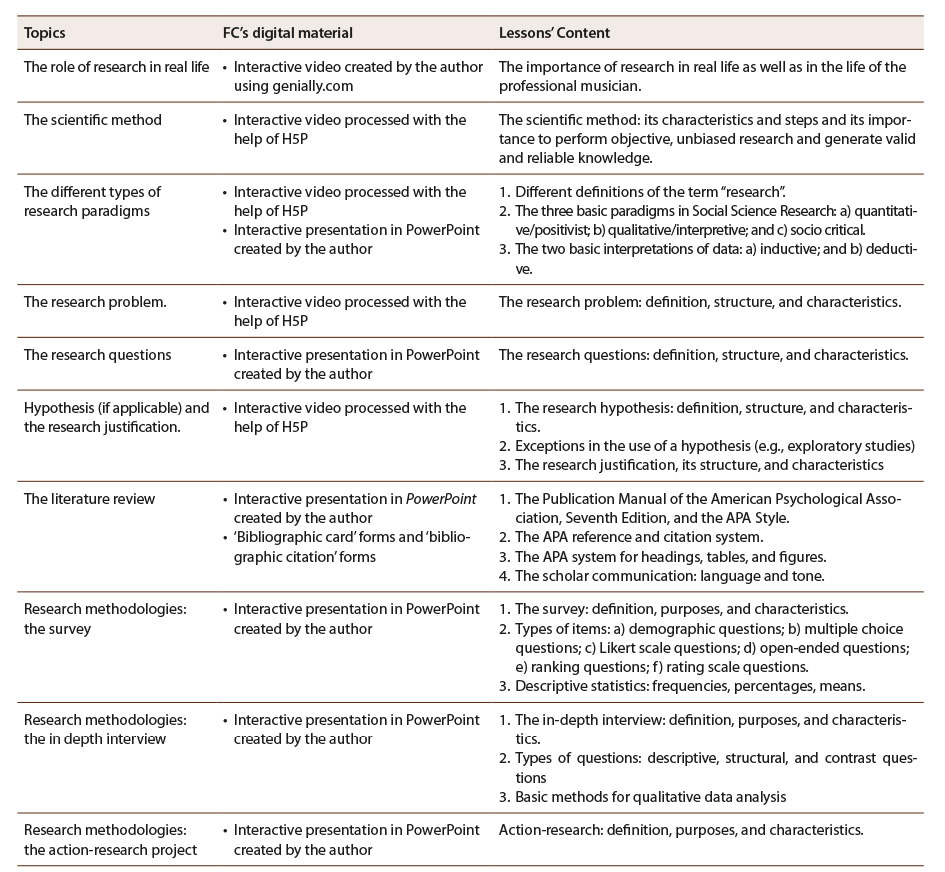
The intervention was developed from August to December 2022. The 18 students enrolled in the class participated in the study. The topics covered throughout the semester, the digital material, and the lessons’ contents are listed in the Table in Appendix A.
Having students already watched the interactive videos and other digital material during the pre-class phase, the in-class lesson began with discussions, questions, and concerns about the content. An important teaching-learning strategy implemented in class consisted of having students present their individual outcomes to the professor and their classmates in order to receive their feedback. For example, in the case of the research problem, each student received feedback concerning its clarity, cohesion, and adequacy during the lesson, so the topics could be elaborated more effectively later on, when students worked on their own.
Students worked on every step involved in the design of a research protocol by following a similar procedure. Every step promoted the student’s involvement in processes of deep critical thinking. Additionally, the fact that individual results had to be presented to their classmates implied that everyone could share thoughts and challenges about the topic, reflect on their classmates’ pros and cons work, and use feedback. For the review of academic research, the professor designed and implemented a couple of filled-out forms called ‘Bibliographic card form’ and ‘Bibliographic citation form’ that had to be completed by students.
The most challenging steps in the process of designing a research project were represented by choosing a methodology and creating the data collection tools or designing the intervention to be implemented in the research-action projects. At this point, it is crucial to explain that because of the number of participants, students were limited to the following types of methodologies and data-gathering techniques: 1) qualitative research design – in-depth interview; 2) quantitative research design – survey; 3) action-research project – intervention. To evaluate the results derived from the selected methodology, students were to use two data-gathering techniques: a) participant and non-participant observation; and b) focus groups.
Methodology
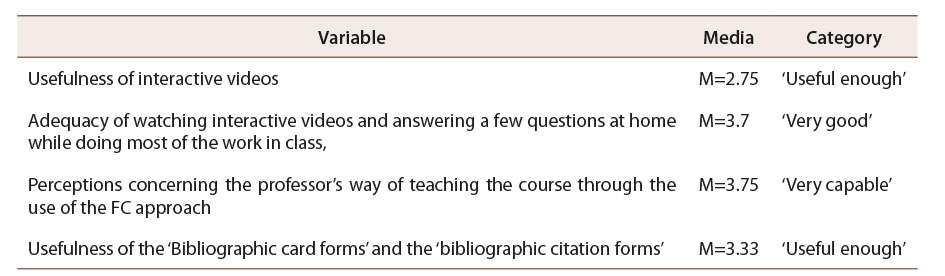
This action-research study in higher education aimed to apply the FC approach in the Seminar on Music Research class. To evaluate the complete implementation as well as the achievement of its goals, the researchers designed an ad hoc questionnaire for students that consisted of 11 items: 2 general questions, 5 Likert scales, and 4 open-ended questions. The questionnaire was applied at the end of the semester. The quantitative data derived from the closed-ended questions were organized into the following four variables below:
• Usefulness of interactive videos,
• Adequacy of watching interactive videos and answering a few questions at home while doing most of the work in class,
• Perceptions concerning the professor’s way of teaching the course through the use of the FC approach,
• Usefulness of the ‘Bibliographic card forms’ and the ‘bibliographic citation forms.
The thematic analysis focused on the information that emerged from the four open-ended questions, according to the inductive approach. The resulting themes are the following:
• Students’ perceptions regarding the FC educational approach,
• Strengths of the FC approach, when implemented in the Seminar on Music Research I,
• Weaknesses of the approach when applied to the Seminar on Music Research I,
• Suggestions or feedback on how to improve the implementation of the FC approach in the Seminar on Music Research I.
In addition, during classes, data was gathered by the professor and the critical friend through non-participant and participant observations. The students’ attitudes, ideas, concerns, questions, and comments were written down in the professor’s reflective diary and the critical friend’s field notes (Feldman et al., 2018). After every class, they reflected on the results obtained through the intervention, discussed the strengths and challenges, revised the plan, and modified any aspect that needed adjustment. The critical friend and the professor’s field diaries included the following categories: students’ attitudes, willingness to work, academic engagement and interaction among themselves and with the professor. The triangulation resulted from contrasting the questionnaire quantitative results, the themes, and the notes from the field diaries.
The research goals for this study were:
1. To determine the students’ perceptions concerning the adequacy of the FC approach when implemented in the Seminar on Music Research I class.
2. To identify the students’ perceptions regarding the strengths and challenges of the FC approach.
3. To determine the students’ perceptions in relation to the professor’s new way of teaching.
Results and discussion
The Flipped Classroom (FC) was implemented in the Seminar on Music Research I to enhance student engagement and improve research method comprehension. Traditional teaching methods had limited success in fostering participation, leading researchers to select this alternative approach. Using action research, data were collected through field diaries, observations, critical friend feedback, and an ad hoc questionnaire. The following sections presents and discusses the study’s results, focusing on students’ perceptions and the benefits and challenges of FC.
The survey results
The questionnaire was sent to the 18 students enrolled in the class, and it was available for them for two weeks. Their participation was voluntary and anonymous. 12 students (67%) with ages fluctuating between 22 and 30 years answered the survey. As shown in Table 1, quantitative results regarding the four of the variables concerned with the adequacy of implementing the FC approach in the Seminar on Music Research I verified that the teaching followed the FC principles, as mentioned above.
Table 1: Variables concerning the adequacy of implementing the FC approach
Note: Table created by the authors.
This outcome represents a good advance compared to the traditional approach of teaching. Furthermore, it signifies room for improvement, for as del Arco Bravo et al. (2019) state, besides the interactive videos, exist a diversity of resources that may be implemented as part of this approach.
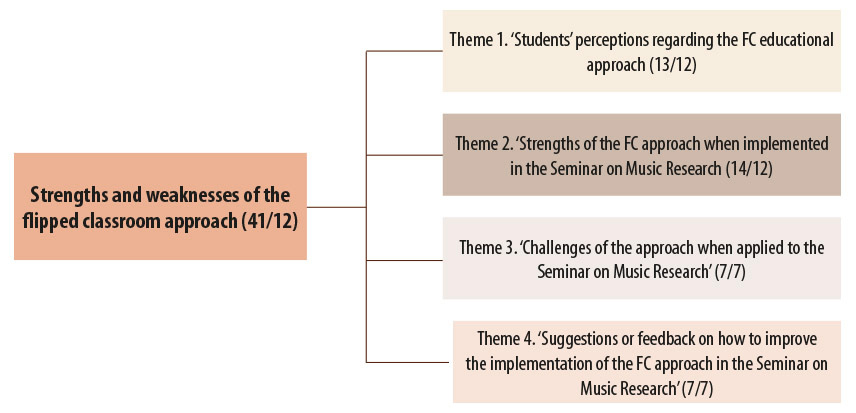
With the purpose of determining the weaknesses and strengths of the FC approach when applied to the Seminar on Music Research from the students’ perspective, the survey included four open-ended questions. The researchers analyzed every answer, identified the units of analysis, and grouped them into themes and sub-themes after identifying a logic that connected them (content analysis). The information was structured, and a conceptual map was created (see Figure 1). After the name of each category there are two digits separated by a slash (e.g., 13/12), they indicate the number of statements relevant to that category and the number of participants who issued them, which in turn allowed researchers to find the most relevant significance patterns.
Figure 1: Themes derived from the four open-ended questions concerning the strengths and weaknesses of the flipped classroom approach
Note: Created by the authors.
Theme 1. ‘Students’ perceptions regarding the FC educational approach (13/12)
Theme 1, ‘Students’ perceptions regarding the FC educational approach’ (13/12) comprised 13 statements that were organized into three sub-themes. Sub-theme 1a, ‘Having a better organization of time’ (5/5), includes statements that indicated the FC approach allowed students to administer their time in more efficient ways. Thus, for example, Student 2 declared: I think it’s the best because you are forced to work on a specific schedule and not leave the assignment for later. I also like it because it saves time and makes you more organized. Student 5 explained: I think it is a great approach. It becomes very practical since each one of us has an individual project, thus it saves us some time and makes us focus more on what each of us requires. Student 9 affirmed: I think it is a good way to take classes, for in the last semesters [in the career] the load of repertoire is too heavy, and, in this way, we can dedicate enough time to each subject. The afore-mentioned results connect with one of the main benefits attributed to this approach: the efficient use of class time by students (Gilboy et al., 2015).
Sub-theme 1b, ‘The FC allows students to immediately resolve the doubts that arise and receive feedback’ (5/5), included statements concerned with the close communication during class between the professor and the students. In this sense, Student 4 explained: When one is working on the practical part, one can instantly ask the professor or fellow classmate to give his feedback regarding the work being done and give his point of view. This result reflects the achievement of another benefit derived from the implementation of this approach, which focuses on the interaction among students as well as with the professor through discussions and questions (Ramírez, 2017).
Finally, sub-theme 1c, ‘The FC allows students to learn at their own pace’ (3/3), contains statements that reflect the freedom to work those students felt in class. In that respect, Student 4 declared: It has been useful for me to work in this way, because when I see the theory at home I can calmly learn at my own pace. Likewise, Student 8 affirmed: From my perspective, I feel that it allows students to advance at their own pace but without anyone being left behind. I feel much more comfortable. Finally, Student 5 stated:
At no time did I feel disoriented in my work. On the contrary, I think this approach helps us to be in tune because if I had any doubts, in a very fluid way, I could solve them with the help of the professor.
This outcome represents an asset derived from the implementation of this teaching-learning approach. As Ramírez (2017) states: Teachers make lessons available so that students can access them when and where it is convenient for them, and then, in class, they apply the concepts of the lessons, establishing actions facilitated by the teacher that motivate an active learning.
As one can see, it is evident that the outcome derived from the Likert scale items connects with the statements that comprise Theme 1 and reflects the achievement of some of the benefits that Reidsema et al. (2017) have attributed to this approach when implemented in higher education, such as the deep engagement of students in the learning process.
Theme 2. ‘Strengths of the FC approach when implemented in the Seminar on Music Research (14/12)
Theme 2, ‘Strengths of the FC approach when implemented in the Seminar on Music Research I (14/12) is concerned with the benefits students have perceived. Answers were organized into three subcategories. Sub-theme 2a, ‘The FC approach favored the deliverance of feedback of good quality’ (6/6), included comments such as the one provided by Student 10: The professor is always available to answer questions, even outside class, or the one given by Student 2: The feedback is very good. It has helped me a lot. The statements provided by the students reflect one of the benefits of this approach since it promotes interaction between the students and the professor. Furthermore, in the post-class stage, the professor had the opportunity to maintain and increase student motivation outside of class time, as well as to assess student progress (Ramírez, 2017).
In sub-theme 2b, ‘The freedom to work at their own pace’ (5/5), students insisted on the liberty they felt throughout the semester, so they made declarations such as: The free manner to learn. To be able to take my process and doubts with greater freedom, without feeling pressured. Having the type of support that is suitable for each of us (Student 5). From the researchers’ perspective, the freedom mentioned by this student reflects the change in the student’s role, from being a passive actor in the learning process to becoming the main protagonist (del Arco Bravo et al., 2019).
Finally, sub-theme 2c ‘The class structure and organization’ (3/3) consists of statements that indicate the FC approach made students feel comfortable. Thus, for example, Student 6 stated: The order and the term dates are very clear, and the activities are achievable. This organization makes the work much easier. Researchers consider this outcome as another important asset, for as Reidsema et al. (2017, p. 15) explain:
The quality of student learning depends largely on how well we design our curriculum and the pedagogies we use within this curriculum. A successful Flipped Classroom (FC) is no exception: to engage students and ensure learning requires carefully considered design and implementation.
It is crucial to point out that all statements in this theme are connected to the F.L.I.P. Pillars: Flexible Environment, Learning Culture, Intentional Content, and Professional Educator, as mentioned in the FLN (2014). Therefore, the finding indicates that the FC was implemented following its tools and principles.
Theme 3. ‘Challenges of the approach when applied to the Seminar on Music Research’ (7/7)
This theme consists of statements that reveal the dislike of students toward the course and other issues they identified during the class. Thus, for example, in Sub-theme 3a, ‘The nature of the subject’ (4/4), Student 2 stated: In general, I don’t like theoretical subjects. However, the truth is that this course has not seemed heavy to me. What I rather dislike is related to the nature of the subject itself and not the teaching. Likewise, Student 6 wrote: I think the subject is well taught. It’s more a matter of taste. Personally, I do not like research very much, which makes the material more tedious. Finally, Student 11 stated:
Overall, as a musician, and focusing on what I had in mind regarding the career, I thought I would be directed towards instrument practice in the last few semesters. Research and written works are not so common throughout the career, so they are tedious. In general, the content is not bad, however having to put in so many hours is what I don’t like.
The statements above-mentioned reflect the resistance to acquiring non-music university skills on behalf of students who have focused on developing performance skills (Carbajal Vaca, 2017). However, it seems that, even though they do not feel too much interest in the class itself, they still considered it was well taught, something that, from the researchers’ perspective, might be due, in part, to the implementation of the FC approach and the benefits that it conveys.
Sub-theme 3b, ‘The lack of time for the professor to work with all the students in class’ (3/3), is represented by complaints that seem to be more objective and closely connected to the FC approach when applied to the Seminar in Music Research I. Thus, Student 7 stated: The problem is that we do not have more teachers to advise us all at the same time. Sometimes class time is not enough for our professor to solve doubts. This information constitutes a call of attention to the researchers since it represents a valid point of view. Certainly, time is always a challenge in teaching, however, much of the success of any teaching-learning approach depends on the wise and efficient use of time class (Gilboy et al., 2015).
Theme 4. ‘Suggestions or feedback on how to improve the implementation of the FC approach in the Seminar on Music Research’ (7/7)
In this final category, the answers of seven students were organized into two subcategories. In sub-theme 4a, ‘Professor lacks time to explain in greater depth some theoretical aspects in class’ (4/4), participants provided statements that pointed out a very important issue: some students did not get enough attention during class. Thus, for example, Student 2 affirmed: I think it would be good to see the theory from time to time during class, in case a doubt arises, or any concerns can be clarified. The student’s comments have made the professor think that probably, in his efforts to ‘flip the classroom’ he left most responsibility to understand the theory to the students, however, as del Arco Bravo et al. (2019) explain, the purpose of this approach is to reduce the time devoted to explaining contents, but not to exclude the explanations in class. Moreover, there is no consensus concerning the use of Information and Communications Technology (ICT) as a determinant factor that facilitates the learning process. Certainly, this feedback on students’ behalf must be seriously considered in order to improve the teaching-learning processes.
Sub-theme 4b, ‘The professor must improve the administration of class time’ (3/3), contains statements that reveal an important weakness on the teacher’s behalf. In this vein, Student 2 stated: The teacher must find ways to better manage the time so that we all get feedback in each class. Observations like that, coincide with one of the answers given to the previous theme concerning the weaknesses identified by students and, very definitely, must be taken into consideration, for, from the researchers’ perspective, it represents the ‘Achilles’s heel’.
The observations from field notes and reflective diary
During the classes, the professor (his/him) and the critical friend observed how students were able to work at their own pace, discussed different concerns with their fellow classmates and with him, made decisions concerning every step of the research process and wrote their projects. Furthermore, in most classes, students got involved in deep and critical processes of reflection. One of the most important findings is that most students were able to identify research problems connected with their own reality and interests, thus, for example, a student who suffered from Attention Deficit Disorder (ADD) developed a project connected to it. That fact made students engage in their projects, take a leading role in their own learning process, and develop their metacognition (categories: a) students’ attitudes and b) willingness to work). However, the professor and the critical friend also observed that the implementation of the FC approach made the organization of the class a real challenge. One of them was represented by giving students adequate feedback on their work in every single class because of the time limit and the variety of students’ questions. To face this situation, the professor made himself available to his students through social media networks, messages, phone calls, emails, and, of course, one-to-one assistance after class (categories: c) academic engagement and d) interaction among themselves and the professor).
Conclusions
The implementation of the FC teaching approach yielded numerous positive outcomes. Students found the interactive videos useful and appreciated the hands-on practical work in class. This approach also enhanced time management and fostered a cooperative atmosphere among students and with the professor. A significant achievement was the students’ ability to work at their own pace while staying on track. This empowered them to take ownership of their learning, and fostered metacognition and critical thinking skills essential in education. The professor’s dedication to providing quality feedback and support further enhanced the learning experience.
Despite some challenges, such as time management issues and students missing aspects of traditional lecturing, the overall impact of the FC approach was positive. Many students have already applied it to their research projects, demonstrating enthusiasm and effectively utilizing their metacognitive abilities. Adjustments may be necessary for future implementation, including better time management strategies and addressing students’ preferences for lecture teaching methods. The implementation of the FC approach became a very rewarding experience. Even though there were a few challenges the researchers had to take into consideration, the professor was able to handle them in the Seminar on Music Research II. Furthermore, the final balance indicated that the positive aspects outweighed the negative results, including the benefits left on the students who have been part of the experience, mainly their disposition to put into practice their metacognitive skills.
Finally, a few students still have feelings of rejection toward this class, as has been pointed out by Carbajal Vaca (2017) and Phelps (1980). However, in spite of that, it is crucial to say that the attitude of all students throughout the semester was that of interest, disposition to work, and willingness to learn. Furthermore, all of them show a steady improvement in the writing of their papers, something that the researchers can attribute to the use of the FC approach.
As this study is the first one which implemented the Flipped Learning approach in higher education in the Music Department at the Autonomous University of Aguascalientes, future research could further explore the long-term impact of the approach on students’ academic engagement, and independent research skills in music education. Expanding the study to include a larger and more diverse group of students or comparing different instructional methods could provide deeper insights into the effectiveness of this approach. Additionally, investigating the role of technology and digital resources in enhancing the FC experience may offer valuable recommendations for educators seeking to optimize their teaching strategies. By continuing to explore these areas, future research in higher education could contribute to refining pedagogical approaches that foster active learning and student engagement, following the technological advancements and adapting them to students’ learning needs.
Authors’ Contributions
The authors declare they have contributed in the following roles: R. W. C. G. contributed to the writing of the article; the management of the research process; obtaining funds, resources and technological support and the development of the research. E. P. contributed to writing of the article; the management of the research process; obtaining funds, resources and technological support and the development of the research.
Data and Supplementary Material
Este artículo tiene disponible material complementario: https://zenodo.org/records/10843831
References
Al-Samarraie, H., Shamsuddin, A., & Alzahrani, A. I. (2020). A flipped classroom model in higher education: A review of the evidence across disciplines. Educational Technology Research and Development, 68(3), 1-33. https://doi.org/10.1007/s11423-019-09718-8
Baker, J. W. (2000). The “classroom flip”: Using web course management tools to become the guide by the side. In 11th International Conference on College Teaching and Learning (pp. 9-17). Florida, United States.
Bergmann, J. & Sams, A. (2012). Flip your classroom: Reach every student in every class every day. ISTE; ASCD.
Cain, T. (2010). Music teachers’ action research and the development of Big K knowledge. International Journal of Music Education, 28(2), 159-175. https://doi.org/10.1177/0255761410362942
Carbajal Vaca, I. S. (2017). Educación musical superior: El desarrollo de competencias profesionales en músicos universitarios. En Memoria Electrónica del XIV Congreso Nacional de Investigación Educativa COMIE (pp. 1-12). COMIE.
Ceniceros Cázares, D. I. (2003). El profesor como investigador: Una perspectiva crítica. Investigación Educativa Duranguense, (2), 4-10. https://dialnet.unirioja.es/servlet/articulo?codigo=2880748
del Arco Bravo, I., Flores Alarcia, Ó., & Silva García, P. (2019). El desarrollo del modelo flipped classroom en la universidad: impacto de su implementación desde la voz del estudiantado. Revista de Investigación Educativa, 37(2), 451-469. http://dx.doi.org/10.6018/rie.37.2.327831
Doi, C. (2016). Applying the flipped classroom methodology in a first-year undergraduate music research methods course. Music Reference Services Quarterly, 19(2), 114-135. https://doi.org/10.1080/10588167.2016.1167427
Drill, K., Miller, S., & Behrstock-Sherratt, E. (2013). Teachers’ perspectives on educational research. Brock Educational Journal, 23(1), 3-17. https://doi.org/10.26522/brocked.V23I1.350
Elliot, J. (1990). La investigación-acción en la educación. Morata.
Feldman, A., Altrichter, H., Posch, P., & Somekh, B. (2018). Teachers investigate their work: An introduction to action research across the professions. Routledge.
Fisher, R., Ross, B., LaFerriere, R., & Martiz, A. (2017). Flipped learning, flipped satisfaction, getting the balance right. Teaching & Learning Inquiry, 5(2), 114-127. http://dx.doi.org/10.20343/teachlearninqu.5.2.9
Flipped Learning Global Initiative (n.d.). Flipped learning definitivo. https://www.flglobal.org/international_definition/
Flipped Learning Network (FLN). (2014, March 12). The four pillars of F-L-I-PTM. https://flippedlearning.org/definition-of-flipped-learning/
Gilboy, M. B., Heinerichs, S., & Pazzaglia, G. (2015). Enhancing student engagement using the flipped classroom. Journal of Nutrition Education and Behavior, 47(1), 109-114. https://doi.org/10.1016/j.jneb.2014.08.008
Goksu D.Y. & Duran V. (2020). Flipped classroom model in the context of distant training. In S. Idin (Ed.), Research on Higher Education and Science (pp. 104-127). ISRES. https://www.isres.org/books/chapters/Rhes2020-104-127_29-12-2020.pdf
Karabulut-Ilgu, A., Jaramillo Cherrez, N., & Hassall, L. (2018). Flipping to engage students: Instructor perspectives on flipping large enrollment courses. Australasian Journal of Educational Technology, 34(4), 123-137. https://doi.org/10.14742/ajet.4036
Kemmis, S. & McTaggart, R. (1988). The action research planner. Deakin University Press.
Kemmis, S. (2009). Action research as a practice‐based practice. Educational Action Research, 17(3), 463-474. https://doi.org/10.1080/09650790903093284
King, A. (1993). From sage on the stage to guide on the side. College Teaching, 41(1), 30-35. https://doi.org/10.1080/87567555.1993.9926781
Llamazares Carballo, A. (2014). Algunas reflexiones en torno al blended-learning. El Guiniguada. Revista de Investigaciones y Experiencias en Ciencias de la Educación, (23), 63-70. https://accedacris.ulpgc.es/bitstream/10553/14024/1/0235347_00023_0007.pdf
Phelps, R. P. (1980). A guide to research in music education. Scarecrow Press.
Ramírez, A. E. (2017). Flipped Classroom: Modelo educativo centrado en el alumno. Docere, (16), 19-22. https://doi.org/10.33064/2017docere161422
Reidsema, C., Kavanagh, L., Hadgraft, R., & Smith, N. (Eds.). (2017). The flipped classroom. Practice and practices in higher education. Springer. https://doi.org/10.1007/978-981-10-3413-8
Rivas Caicedo, L D. (2012). Nuevos retos para la educación musical. El docente de música como investigador. Revista da Abem, 20(29), 11-22. http://abemeducacaomusical.com.br/revistas/revistaabem/index.php/revistaabem/article/viewFile/87/72
Scön, D. A. (1992). La formación de profesionales reflexivos. Hacia un nuevo dCiseño de la enseñanza y el aprendizaje en las profesiones. Paidós.
Sever, I., Öncül, B., & Ersoy, A. (2019). Using flipped learning to improve scientific research skills of teacher candidates. Universal Journal of Educational Research, 7(2), 521-535. https://doi.org/10.13189/ujer.2019.070225
Universidad Autónoma de Aguascalientes. (2017). Licenciatura en Música. Rediseño de Plan de Estudios 2017. Centro de las Artes y la Cultura. Departamento de Música.
Vilar Torrens, J. M. (2008). Jóvenes músicos, formación académica y mundo laboral. Musiker, (16), 341-350. https://core.ac.uk/download/pdf/11502464.pdf
Appendix A: Topics, FC’s digital material and lessons’ content covered throughout the semester August-December 2022

Artículo de la Revista Electrónica Educare de la Universidad Nacional, Costa Rica by Universidad Nacional is licensed under a Creative Commons Attribution-NonCommercial-NoDerivs 3.0 Costa Rica License.
Based on a work at https://www.revistas.una.ac.cr/index.php/EDUCARE
Permissions beyond the scope of this license may be available at educare@una.ac.cr