Revista Electrónica Educare (Educare Electronic Journal) EISSN: 1409-4258 Vol. 29(3) SETIEMBRE-DICIEMBRE, 2025
doi: https://doi.org/10.15359/ree.29-3.20030
https://www.revistas.una.ac.cr/index.php/educare
educare@una.ac.cr
[Cierre de edición el 31 de diciembre del 2025]
Students’ Perceptions of and Responses to Oral Podcast Feedback on Their Writing
Percepciones y respuestas de estudiantes sobre retroalimentación a sus escritos vía podcast
Percepções e respostas de estudantes universitários em relação aos comentários orais por meio de podcasts sobre seus escritos

Roxanna Correa-Pérez
Universidad Católica de la Santísima Concepción

Concepción, Chile
rcorrea@ucsc.cl
 https://orcid.org/0000-0002-2035-4282
Mónica Tapia-Ladino
Universidad Católica de la Santísima Concepción
Concepción, Chile
https://orcid.org/0000-0003-2951-1798
Recibido • Received • Recebido: 05 / 06 / 2025
Corregido • Revised • Revisado: 17 / 12 / 2025
Aceptado • Accepted • Aprovado: 21 / 12 / 2025
Abstract
Introduction. This study proposes an approach to developing English writing skills through oral feedback delivered via podcast. Feedback is regarded as a fundamental component of the academic writing learning process. In particular, feedback provided on writing tasks has been the focus of extensive research, such as that conducted by Christiansen and Bloch (2016) and Sommers (2013). We suggest that personalized attention can be achieved through oral feedback via podcasts. Some authors indicate that audio feedback triggers a sense of connectivity between the teacher and the student (Kirwan et al., 2023). Aim. The aim of this research was to investigate students’ perceptions and actions towards the use of podcasts as a method of receiving feedback. Methodology. This is qualitative research. The data collected were the perceptions and actions of university students on their writing tasks in an English as a Foreign Language (EFL) class. The participants were 26 university students majoring in English as a second language and taking a course that included process writing. A semi-structured interview was conducted with the participants to gather their perceptions and actions after receiving oral feedback via podcast. Results. The results indicated that the participants valued and considered detailed and precise oral feedback. They expressed positive feelings about the tone of the teacher’s voice and the direct relationship between the feedback received and the task.
Keywords: Formative assessment; oral feedback; teaching English as a second language; writing in English.
SDG: SDG 4; quality education; writing skills.
Resumen
Introducción. Este estudio propone una forma de desarrollar las destrezas de escritura en inglés mediante la retroalimentación oral proporcionada a través de podcast. El feedback se considera un aspecto fundamental en el proceso de aprendizaje de la escritura académica. En particular, la retroalimentación dada en tareas de escritura ha sido objeto de diversas investigaciones como Christiansen and Bloch (2016), Sommers (2013). Sugerimos que la atención personalizada puede lograrse mediante el feedback oral a través de podcasts. Algunos autores indican que la retroalimentación auditiva desencadena un sentido de conectividad entre el profesor y el estudiante (Kirwan et al., 2023). Objetivo. El objetivo de este estudio fue investigar las percepciones y acciones de los estudiantes hacia el uso de podcasts como método para recibir retroalimentación. Metodología. Es una investigación cualitativa, los datos recolectados fueron las percepciones y acciones de estudiantes universitarios sobre sus tareas de escritura en una clase de inglés como lengua extranjera (EFL). Los participantes fueron 26 estudiantes universitarios de una carrera de Pedagogía en inglés, como segunda lengua, cursando una asignatura que incluía escritura de proceso. Se realizó una entrevista semiestructurada a los participantes para recoger sus percepciones y acciones tras recibir feedback oral a través de podcast. Resultados. Los resultados mostraron que los participantes valoraban y consideraban la retroalimentación oral detallada y precisa. Expresaron sentimientos positivos sobre el tono de voz del profesor y la relación directa entre el feedback recibido y la tarea.
Palabras claves: Enseñanza del inglés como segunda lengua; evaluación formativa; retroalimentación oral; escritura en inglés.
ODS: ODS 4; educación de calidad; habilidades de escritura.
Resumo
Introdução. Este estudo propõe uma forma de desenvolver as destrezas de escrita em inglês mediante a devolutiva por meio de podcast. O feedback é considerado um aspecto fundamental no processo de aprendizagem de escrita acadêmica. Em particular, a devolutiva dada em tarefas de escrita tem sido objeto de diversas pesquisas, como Christiansen e Bloch (2016); Sommers (2013). Sugerimos que a atenção personalizada pode ser alcançada por meio do feedback oral, com o auxílio de podcasts. Alguns autores indicam que a devolutiva auditiva desencadeia um sentido de conexão entre o professor e o estudante (Kirwan et al., 2023). Objetivo. O objetivo deste estudo foi analisar as percepções e as ações dos estudantes em relação ao uso de podcasts como meio para receber devolutivas. Metodología. Trata-se de uma pesquisa qualitativa, os dados coletados foram as percepções e ações de estudantes universitários sobre suas tarefas de escrita em uma aula de inglês como língua estrangeira (ILE). Os participantes foram 26 universitários, que se formavam em inglês como segunda língua, de um curso de Pedagogia em inglês que participaram de uma disciplina que incluía processo de escrita. Realizou-se, com os participantes, uma entrevista semiestruturada para coletar suas percepções e ações depois de receber feedback oral mediado por podcasts. Resultados. Os resultados mostraram que os participantes valorizavam e consideravam a devolutiva oral detalhada e precisa. Expressaram sentimentos positivos sobre o tom de voz do professor e a relação direta entre o feedback recebido e a tarefa.
Palavras-chave: Avaliação formativa; devolutiva oral; ensino de inglês como segunda língua; escrita em inglês.
ODS: ODS 4; educação de qualidade; habilidades de escrita.
Introduction
This study investigates perceptions of, and responses to, providing oral feedback on the academic writing of university students via podcast. It proposes a method of developing English writing skills through the provision of oral feedback via a tool such as a podcast. The Literature review section will therefore explain the concepts of feedback, oral feedback, and using podcasts to deliver feedback.
Literature review
Writing in higher education is a complex challenge for students, as they need to demonstrate understanding and discipline-approved knowledge while also developing their own original identity and contribution to the field of study. A way to promote students’ writing is through the provision of feedback. This practice can help students reduce the gap between their current performance and expected performance, improving their cognition, motivation, and behavior, especially when facing academic writing tasks. Some authors, like Esterhazy (2019) or Winstone and Carless (2019) state that feedback helps students to understand the comments provided by their tutors and facilitates the learning of the genre required in the written task. An alternative to written feedback is oral feedback or audio feedback; this type allows for immediate response and the opportunity for negotiation and clarification of doubts. Moreover, it allows students to revise the feedback at any time, promoting more efficient and self-directed learning. The use of technological tools, such as podcasts, can help improve students’ effectiveness and readiness to receive feedback by humanizing the process and promoting a sense of academic community. In this context, the aim of this study is to research the perceptions and actions of university students about receiving feedback via podcast.
During the formative process of teaching writing, the revision is typically carried out by a teacher or peers. This process involves a dialogue (Dawson et al., 2019) in which feedback is provided on the current state of the writing and the necessary elements of the genre that the writer needs to achieve. The feedback provided is intended to help the writer improve their writing and better understand the conventions of the genre (Arancibia Gutiérrez et al., 2019). Therefore, it is a resource that monitors both the writing process but also serves as a powerful tool to convey the required genre.
The process of providing feedback has been described from different points of view, such as the learner´s experience with feedback, feedback and engagement feedback impact, emotions in feedback, dialogic feedback, personalized feedback (Henderson et al., 2019; Molloy et al., 2019). Along these lines, Carless (2019) proposes a model of the learner experience of feedback that considers: experiences, students’ motivation, type of feedback provided by supervisors, teaching, and learning context of the feedback provided.
Research on written feedback has primarily focused on the characterization of written comments (WC) and has proposed classification systems based on the normative, textual, or discursive norms of the language (Arancibia et al., 2019). However, there has been limited research on the genre dimension of written feedback, which suggests that written comments are elements that help writers conform their writing to the conventions accepted by a particular discourse community (Correa Pérez et al., 2021). The genre emphasizes the importance of understanding the conventions and expectations of a particular genre to provide effective feedback.
By providing genre-based feedback, teachers are helping students to understand and adopt the several characteristics that different texts have (Tapia-Ladino et al., 2017). This approach emphasizes the importance of understanding the conventions and expectations of a particular genre, which can help students to become proficient writers in that genre. Additionally, genre-based feedback can help students to develop an understanding of the different features that different types of texts have, and how to effectively use these features in their own writing. The authors propose that the main problems or difficulties students face when writing are not only related to the normative aspects of the language. If we consider and assess these aspects within the context of a discourse genre, they are more meaningful and useful for the students’ writing.
The provision of systematic and gender-oriented feedback can help students understand and adopt the expectations and writing conventions of their discipline, thereby enhancing their ability to write effectively and contribute meaningfully to their field of study. However, it is important that feedback is provided effectively and that students are prone to receive it and use it to improve their writing. Driscoll and Wells (2012) referred to this disposition as the willingness to engage in their task.
Podcast as a resource to provide feedback
Podcast as a resource to provide oral feedback is considered an alternative to written comments, and in this study, is considered equivalent to oral feedback. Podcasting can be defined as a means of distribution and a medium for audio content. It is a way for media files to be easily distributed across the Internet to subscribers, often as part of an ongoing series (Berry 2019). Podcasts can be listened to on a variety of devices, such as smartphones, computers, and smart speakers. It is based on the idea that the teacher’s feedback is the result of a negotiated understanding of the student’s work.
Sommers (2013) argues that recorded feedback (or feedback via podcasting, as in this study) is beneficial for students as it provides a familiar and motivating tone that students find easier and friendlier to receive. This positive attitude towards teachers’ feedback promotes a better understanding of the comments provided. Recorded feedback allows students to replay the feedback multiple times and to listen to it at their own convenience, promoting more efficient learning. This type of feedback also allows students to listen to the teacher’s intonation and tone, which can convey important information as well.
Some authors indicate that audio feedback triggers a sense of connectivity between the teacher or tutor and the student (Kirwan et al., 2023). In the words of Bond (2009), audio feedback is easier to understand for students since written feedback is often not as clear as audio feedback. In the line of the same author, he pointed out that audio feedback provides the opportunity to emphasize and communicate ideas and feelings through intonation and changes in the pitch that is something impossible to communicate in written feedback. In a complementary sense, CETL (2020) proposed four different positive aspects of audio feedback. Firstly, it enhances personalized learning, meaning that feedback becomes more personal when it is given in audio-recorded form. Hearing the voice of the teacher and sometimes the name of the student in the recording makes it more personalized. The second aspect highlighted in the research is that audio feedback opens the possibility of detailed feedback; for example, audio feedback allows a teacher to explain themselves better and provide better explanations for complex matters. The third aspect has to do with efficiency; as previously stated, audio feedback is not a time-consuming process. The fourth aspect mentioned in the research is that students are more likely to prefer and to take into consideration oral feedback rather than written feedback. Non-verbal signals such as tone of voice and rhythm contribute to the understanding of oral feedback and favor students’ willingness to modify their texts. This suggests that the use of non-verbal cues in oral feedback provides a better understanding of it and increases the probability that students will apply the suggested changes in their texts.
A study conducted by Lunt and Curran (2010) found that audiotape feedback is more efficient than other methods, such as written or typed feedback. They stated that this method allows teachers to provide feedback more quickly, which is a concern among teachers. Additionally, the study found that both tutors and students prefer this type of feedback, with tutors finding it more efficient and effective in terms of time-consuming for tutors and students’ engagement with the feedback provided. Therefore, students show a more positive response to it.
Perceptions and feedback via podcast
The main aim of this study is to research the perceptions of university students regarding receiving feedback via podcast. Therefore, it is relevant to review this concept and studies related to this topic. In this regard, Anson et al. (2016) argues that there has been a lack of research on students’ perceptions of feedback in composition studies. The author states that composition studies have primarily focused on what teachers do, rather than what happens to students. The author suggests that the assumptions about what works for students’ learning are mainly based on the analysis of teachers’ comments, without enough consideration of students’ perspectives. It would be valuable to conduct more research on student perspectives on feedback, as it could provide insight into how feedback can be more effective for student learning.
Putri et al. (2021) conducted a study on students’ perceptions of feedback. They analyze senior EFL students’ perceptions of receiving feedback. In this study, it was found that most of the students perceived feedback as positive because it provided further learning; furthermore, teacher feedback was demonstrated to develop students’ self-regulated learning. According to the presented authors, effective feedback helps students to improve their skills, such as their writing skills. Additionally, effective feedback promotes independent learning among students.
In a study conducted by Tapia-Ladino et al. (2017) at the university level, the authors aimed to investigate the perceptions of both students and teachers regarding feedback received and provided, respectively, in the context of dissertation writing. The study likely aimed to understand how feedback is perceived by both parties and whether there are differences in the way feedback is perceived by students and teachers in this context of dissertation writing.
The results of this study may provide insight into how feedback can be given and received more effectively in the dissertation writing process. The authors of this study suggest that students tend to view comments made by teachers as a reflection of the teacher’s personal characteristics. For example, if a teacher provides detailed comments, students may view the teacher as a detail-oriented person. In addition, the authors suggest that teachers also view feedback, especially written comments, as a way of achieving a written text that meets the requirements of a particular genre. Feedback via podcast provides more opportunities to focus on the genre aspects because it is seen by students as a friendly way to receive feedback.
An important antecedent that is relevant to mention is the National Student Survey (NSS), which is applied in all UK universities, to collect students views on their learning experience. In the dimension that focuses on assessment and feedback, results have been consistently lower compared to other areas such as teaching and learning opportunities and academic support among others. Students are less satisfied with the timelines of feedback received and the quality of support offered (less than 70%).
Method
Before presenting the methodological proposal and the results of the study, the lead author declares her positionality to maintain the contextual perspective that is typical of qualitative research adopting a situated lens. It should be noted that the participants in this study were her students in the subject indicated below. This positioning has two important implications. The first is that the study stems from personal motivation, a sense of ownership of the problems presented. As a professional expert in writing and with a discursive identity akin to the humanities, she wondered what her students’ experience would be after receiving oral feedback through podcasts. Indeed, the possibility of bias in the study was one of the reasons why she felt it was essential to follow processes of reliability and advice on instrument construction at all stages of the methodology and to seek expert support. The second important implication is that this situation facilitated data collection and understanding of the context, as well as allowing participants to be fully aware of the characteristics of the research and how it was taking shape.
This research was conducted at the university level in an academic English course. The study is qualitative in nature and uses a phenomenological design. These designs focus on the subjective individual experiences of the participants (Salgado Lévano, 2007). The research materials include the students’ writing process of an academic writing task and the teachers’ oral feedback on two consecutive drafts. The teacher recorded the oral feedback on their computer and sent it directly to the student’s email address after 4 weekdays.
Participants
Twenty students in the fourth year of their face-to-face study programme and one teacher from the same English teaching program at a traditional university in southern Chile participated. Once graduated, they will teach English as a foreign language at secondary level. The study was conducted over a period of 6 weeks, and the participants were part of the course entitled Assessment Methods and Approaches to the English Teaching Methodology. They all agreed to participate on a voluntary and informed basis. The inclusion criteria applied were for the students: to produce a written work with a draft revision, and for the teacher: to provide feedback via podcast.
Data Collection
Assignment description. First, the students had to design tasks to develop receptive and productive skills, including aspects of vocabulary, grammar, and phonetics. These activities should be contextualized, considering the Chilean secondary school context. Second, students had to decide the grade the tasks would be implemented in, describe the tasks, write the instructions for the students, mention what materials they would use, and decide on what type of scoring instrument they would use to assess the tasks designed. In addition to the proposal of the communicative tasks, students had to choose 5 texts already read in class and report on them in an annotated bibliography, including the reference of the text in APA format, main ideas and authors, findings, and a reflection on the contribution of the text to their future profession as teachers of English. The iterative nature of the task provides different opportunities to respond to feedback: on the one hand, they could revise and resubmit their drafts, and on the other hand, they could send a podcast to the teacher with their initial reactions or level of understanding of the feedback received.
The main steps of the feedback sequence have been organized into 3 phases. In the first phase, the teacher discusses the assignment guidelines and the analytical rubric for assessing the assignment with the students. The students write their first draft. In the second phase, after the students had written their first draft, the teacher sent the first podcast feedback, and some students sent back a podcast explaining their level of understanding of the comments received. After listening to the teacher’s oral feedback, all students sent the revised assignment. In the third phase, the teacher reviewed the final assignment and marked it using the rubric. Finally, students revised and discussed the results of the final assignment using the rubric.
Data Analysis
A semi-structured interview was used, formulated to ascertain students’ assessment of the feedback received. In total, we analyzed 26 transcripts: 20 corresponded to the interviews conducted with the students and 6 to the audios of reactions to the teacher’s podcast.
Some examples of questions are the following: How did the audio feedback from your teacher help you in the process of completing your assignment? / What types of audio comments from your teacher were easier to understand? Why?
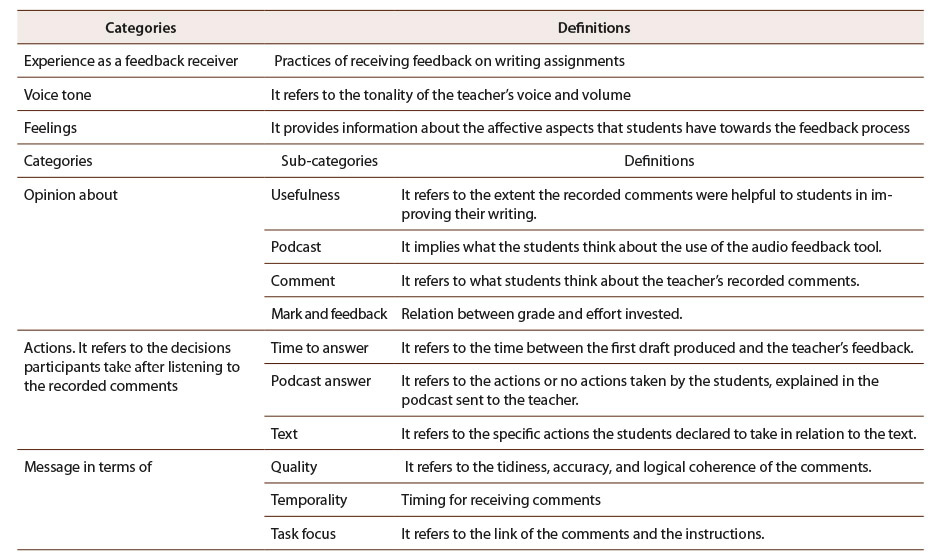
We analyzed the data, applying theoretical and emergent categories. Table 2 shows the corresponding definitions of categories and subcategories applied in the study. The categories of analysis were adopted from a previous project applied at secondary level in 2017 and modified through the revision of the theory by Lim et al. (2021); Pekrun and Linnenbrink-Garcia (2012); These categories were validated by academic experts in the field and modified according to their suggestions. In Table 1 we explicit the categories and subcategories of analysis and its definitions.
Table 1: Categories and subcategories
Note: Own elaboration.
An initial exploratory list of codes was generated and adjusted in two successive rounds of work. The researchers iterated among themselves to stabilize a book of 7 codes with operational definitions and examples. The categories used corresponded to a descriptive coding (Saldaña, 2016) on themes associated with the activity that takes place when students receive podcast feedback.
The interview materials and audio feedback responses were transcribed in full and analyzed with the help of qualitative analysis software, or CAQDAS. To give reliability to the analysis the investigators of the research coded 2 interviews using the same interview book with an average kappa of 0.71, which corresponds to considerable agreement. At the end of the process, the researchers audited the analysis of 20 interviews and 6 students´ audio reactions to the podcast. Finally, the codes were used to access the information and identify elements of interest and construct the patterns of interpretive results reported in this article.
Results
The results of this study provide insight into university students’ perceptions regarding receiving feedback via podcast. And the actions they reported taking after receiving this type of feedback. Some selected results are presented for each category of analysis.
The first category, related to previous experiences with feedback, most of the participants commented that the feedback they have received was mostly written and mainly consisted of grammar and vocabulary correction rather than ideas. Some students commented on the following:
Most of the feedback that I have received is on writing but is mainly grammar or vocabulary correction, so that’s the main concern when it comes to the feedback from my teachers. (Student 1)
At first, I didn’t recognize its importance or usefulness until I received feedback from people I trusted. And that is when I started to appreciate feedback. (Student 15)
Although this previous experience was initially seen as useless, the student recognizes the importance of the feedback if he/ she trusts the person giving it. Most of the students interviewed reported that the podcast feedback played a role in making them feel good about their text through the tone of the teacher’s voice. Some students illustrated this feeling in the following way:
I remember it was a good tone of voice, I could understand everything she said, she didn’t sound bored, she didn’t sound tired, she didn’t sound angry, it was just her talking to a student and that helps a lot, because if you have a teacher that text to you in a manner that sounds angry you don’t ask further questions. (Student 8)
These findings support what CETL (2020), Killingback et al. (2019) found about how the teacher’s tone of voice can contribute to the understanding of feedback and activating a response as one of the students reported:
I appreciated that she was respectful and kind. It helped to make the reception of the feedback more enjoyable. (Student 18)
In addition to the possibility of hearing the teacher’s voice, students also express their feelings about receiving feedback via podcast. Students reported the following:
I would say it makes me feel good. It eliminates uncertainty about what I’m doing wrong. Listening to feedback and knowing what the teacher wants exactly, it is very useful, and I like that. (Student 12)
The sense of surprise and the degree of accuracy of the feedback sent elicit positive feelings in the students that were interviewed. According to Pekrun and Linnenbrink-Garcia (2012) there are some feelings that activate or deactivate students’ actions, in this case responding or not responding to the feedback received.
Students also shared their views on the use of podcasts to provide feedback, the quality and complexity of the comments, and the relationship between the feedback and the grade received. Participants reported that the audio feedback was very useful because they could listen to it as many times as they wanted and that it was easier to follow than written feedback and more personalized. Two of the students interviewed reported the following:
The audio format has been very beneficial simply because I can listen to it more than once. (Student 10)
I found it easier to understand when she directly addressed the mistakes. Honestly, like not trying to sugarcoat it too much, like not necessarily being brutally honest, but being honest. (Student 15)
This idea of receiving feedback that directly addresses the mistake seems to contribute to understanding and probably to action. This specificity in the comment and the possibility of listening to the audio feedback whenever they need it, triggers/activates a perception of success (Pekrun et al., 2023). Referring to the feelings the feedback podcast produced, the students reported the following:
Also thank you for the congratulations you give us in our reading log (task) regarding the reflections we gave. I’m glad you liked them, Miss, so see you in class and I wish you a good weekend. (Student 2)
Students expressed feelings of gratitude for the feedback and for the fact that congratulations were included. Liu and Yu (2022) conducted a study on written feedback with master students. They found out that gratitude was the most common emotion reported by the students.
Quality and complexity of the comments. The students interviewed mostly mentioned that the comments were clear and accurate, but they could have been a bit longer. Complexity was not an issue; students reported the comments were quite concrete and to the point.
I think all of them were easy to understand, personally. They were very concrete things and easy to follow. So, I really didn’t have a problem with that. (Student 12)
I think it could be longer than it was, like it was, around two minutes, and she focused on a lot of points of the work, but I would like it to be a bit longer. (Student 11)
These characteristics are closely related to the provision of feedback via podcasts; podcast comments need to be focused and allow teachers to provide feedback more quickly, as Lunt and Currant (2010) state.
Grade and feedback. It refers to the relationship between the qualification obtained and the effort invested. To illustrate this sub-category, some students explained that:
Due to that the feedback she gave to us was clear, was correct, was accurate and everything and we improved everything she said, but we didn’t receive the mark we expected. (Student 11)
I think the mark received corresponded to the feedback received. That was because I paid attention to all the things the teacher said in the podcast feedback. And at the end, I did pretty good thanks to the comments. (Student 19)
Some students reported that they expected a higher grade because of the comments they received. They may have assumed that the grades will be equally friendly, because of the comments tone. It is important to note that the audio feedback and the grade given were based on an analytical rubric. In their research on grading Guskey and Brookhart (2019) state that we need to focus on the feedback function of grades. Along these lines, Link and Guskey (2019) point out that the students´ feelings about grades determine the actions they decide to take in a particular task. In this study students first received feedback and then the grades which may explain some feelings of disappointment with the grades received.
Students also reported the actions they take after listening to the audio comments. This category is defined as the actions taken by the participants after listening to the recorded comments. It includes the following sub-categories: time to answer, podcast answer, and actions in the text. Time to answer/respond refers to the time between the first draft produced and the final version after receiving feedback. Podcast Answer refers to the actions reported by students in the podcast sent to the teacher. Finally, actions in the text refer to the modifications students reported having made in the interview.
The actions reported by the students in the audio sent to the teacher were mainly the following: listening to the audio, noticing the mistakes, and making the necessary changes in the text, all these actions at the same time. They also reported that they went back (to the audio) every time they needed to.
When I received the audio, I listened to it many times. I was working on the computer and listening to the audio to follow what the teacher was saying. (Student 13)
The message is another aspect that students referred to, specifically the message in terms of its quality, timing, and task focus (see definitions in Table 2). Some evidence that students provide in relation to the quality of the message are:
Pretty much accurate like she said what was needed to be said, not unnecessarily dragging on into an additional idea or making like those additional maybes, nothing like that, that was completely professional and adequate. (Student 15)
In terms of temporality, which means receiving comments close to the due date of the assignment or before the due date, students mentioned the following:
I prefer to receive it as far away as possible from the due time, because that way I don’t feel this big rush to complete my assignment, and I feel that I have more time to work with the feedback given. (Student 15)
I prefer feedback in the process, or time before it is all over, so you can improve the process and learn. (Student 13)
Feedback that is task-oriented encourages students to understand the feedback and the task they are working on. In this research we propose the category of task focus, which refers to the link between the comments provided and the instructions given.
She didn’t waste time asking how you are today? Maybe she greeted us, but I don’t really remember that, but obviously it was about the task. Because she’s the teacher and we have no extra time. We have assignments to do, we have a lot to accomplish in a short time, as you know, learners’ first enemy is time. (Student 20)
The results of the research indicate that students have a positive perception of using podcasts to receive feedback. They find it more personal, as if they were talking to the teacher. They also appreciate the autonomy that audio feedback gives them, as they can listen to it whenever they want and as many times as they need.
As was mentioned in the Methods section, students could send a podcast to the teacher with their initial reactions or level of understanding of the feedback received; 6 of them did it. The students mostly commented on the actions they implemented in the text, for example:
We tried to fix the APA format in the reading log task. I will ask you to let us know once you have access to our work. Thank you so much for listening. (Student 24)
The feedback received, via podcast, made them realize the mistakes they had made, and were able to make the changes needed. In the same line, another participant added.
The comments received were important for us and we are going to improve our work by sending you the last version of it, so thank you very much for your feedback. (Student 21)
In relation to the use of podcasts to provide feedback, students valued the accuracy of the comments in terms of being able to locate the information and the accuracy of comments in terms of targeting exactly what needed to be improved.
Discussion
The research aimed to find out how students perceive and accept the use of podcasts as a method of receiving feedback. The use of a qualitative data method allowed us to find out how students received the feedback offered via podcast to university students in an English as a Second Language Program. The results show that students value the offer of feedback and make connections between the actions taken and the final grade. Feedback allows students to identify errors, take actions to improve, and relate that effort to the grade.
As the analysis shows, the students in this study perceived that podcast feedback gave them a sense of close communication with the teacher, and at the same time it facilitated their understanding of the feedback they received. The podcast technology has helped to create a space for interaction between students and the teacher, mainly through aspects such as the tone of the teacher’s voice, naming the students at the beginning of the audio feedback, and giving accurate and positive comments. Correa Pérez and Flores Flores (2018) note that positive feedback enhances the learner’s willingness to revise. This finding is consistent with other studies where students have positive perceptions about audio feedback (Lunt & Curran, 2010; In these studies, most of the students described audio feedback as positive and beneficial to them, as it allows them to identify their mistakes and how to improve them.
Specifically, the podcast feedback gave the students a sense of personalization (CETL, 2020) and a sense of connectivity with the teacher (Kirwan et al., 2023). They particularly valued the positive comments related to the sections where they had put in a lot of effort, which gave them a sense of achievement and motivated them to improve their writing. In recent research carried out by Rawle et al. (2018), most of the students described audio feedback as positive and beneficial for them since it allows them to identify their mistakes and how to improve them. They declare the following: “I feel that the audio feedback positively benefited me, because the audio feedback felt more instructional” (Rawle et al., 2018, p. 7).
In terms of the accuracy of the message, it is interesting to note that there are two main aspects the students valued: the message containing comments directly related to the task and the clear and precise indication of which part of the text they were referring to. This finding differs from Mahoney et al. (2019) who assumes that audio comments can be confusing for the students because there are no annotations or signs in the text. The researcher of this study registered a copyright in 2021 (Nº: 2021-A-1017) and established a clear sequence for providing podcast/audio feedback. One of the steps in the sequence is to make a specific reference to the part of the text that has been commented on. The sequence includes the following steps: Comments begin with reference to the student’s name. The number of comments to be given is decided in advance. Attention is paid to the tone of the comment. Reference is made to the marked text in the recording. Feedback starts and finishes with a positive comment (Correa, 2021).
According to Pekrun and Linnenbrink-Garcia (2012), the emotions manifested by students can affect their motivation and have an impact on their academic performance. For example, emotions can activate students in such a way as to affect how they perform in an assignment. The participants in this study attached great importance to the personalization of the comments and the teacher’s voice tone, as these aspects motivated them to make the necessary changes in their texts. Evidence from Lim et al. (2021) supports the idea that emotions play a functional role in feedback as they shape student’s motivation. In addition, the use of audio feedback promoted the affective aspects of receiving feedback. Anson et al. (2016) conducted a study of audio feedback via screencast, and his findings also suggest that audio feedback can reduce threats and frustration.
In terms of actions, students tend to do what they are asked to do. They identified the mistakes and tried to correct them. This process of identifying mistakes is a key aspect. If they understand what was wrong and know how to correct it, they are able to successfully modify their texts. Sometimes, however, students identify their mistakes, but they don’t know how to correct them (Esterhazy, 2018). In this study some students mention that they expected a better mark. We can speculate that this is due to the friendly tone of the teacher’s voice in the feedback received before the final text. Students may have assumed that the mark would be better than it was. Another possible explanation is that the oral feedback provided focused more on the positive aspects of the students’ texts. In addition, some students reported they were used to receiving feedback that only pointed at the mistakes. On the contrary, audio feedback has a more positive effect on the students, making them feel that the quality of their writing has been valued.
Conclusions
The study demonstrates that focused, detailed, and personalized audio feedback enables students to make substantial changes to their writing. Feedback acts as a stimulus that triggers actions, generates changes in writing, and establishes a working attitude towards writing. Essentially, podcast feedback allows students to identify problems in their writing, plan a course of action, and establish relationships between their efforts and the grade. In this process, they value the tone of the teacher, the level of detail in the observations, and the precision on how to solve their mistakes. Students reported that they tended to make changes to the text while listening to the audio feedback. In the same vein, students also made modifications after listening to the audio, taking advantage of the feature of the feedback that can be recorded and replayed as many times as desired. This supports the idea that students like oral feedback through podcasts because it is easier to understand, does not lead to misinterpretations, and provides positive comments, different from the most common written feedback (Bond, 2009).
The feelings reported by the students support Lim et al. (2021) statements as they show the engagement between the students and the feedback through the positive feelings such as joy, relaxation, and feeling comfortable with the audio feedback received. Furthermore, the students’ feelings were positively activated as some of them stated that this was the first time they had received this type of feedback, in other words, it motivated their work.
However, it is not possible to generalize, as this study was carried out with a few number of students. There is a need for further research to show how students perceive the feedback they receive from their teachers and what features of the feedback facilitate learning and include aspects such as the teacher’s tone, and the structure of the feedback provided.
Learning from this research experience can lead to an analysis with larger samples, which will allow more generalizations to be made and provide guidance to teachers on how to provide feedback that promotes learning.
Contributions
The authors declare they have contributed in the following roles: R. C. P. contributed to the writing of the article; the management of the research process; obtaining funds, resources and technological support and the development of the research. M. T. L. contributed to the writing of the article; obtaining funds, resources and technological support and the development of the research.
Data and Supplementary Material
This article has supplementary material:
Preprint: https://doi.org/10.20944/preprints202506.0265.v1
Acknowledgements
We thank Dirección de Investigación de la Universidad Católica de la Santísima Concepción, Chile, for the academic and financial support for carrying out this research.
References
Anson, C. M., Dannels, D. P., Laboy, J. I., & Carneiro, L. (2016). Students’ perceptions of oral screencast responses to their writing: Exploring digitally mediated identities. Journal of Business and Technical Communication, 30(3), 378-411. https://doi.org/10.1177/1050651916636424
Arancibia Gutiérrez, B., Tapia-Ladino, M., & Correa Pérez, R. (2019). La retroalimentación durante el proceso de escritura de la tesis en carreras de pedagogía: Descripción de los comentarios escritos de los profesores guías. Revista Signos, 52(100), 242-264. http://dx.doi.org/10.4067/S0718-09342019000200242
Berry, C. (2019). La voz y el actor. ALBA Editorial.
Bond, S. (2009). Audio feedback. Centre for Learning Technology. https://www.researchgate.net/publication/48910115_Audio_feedback
Carless, D. (2019). Learners’ feedback literacy and the longer-term: Developing capacity for impact. En M. Henderson, R. Ajjawi, D. Boud, & E. Molloy (Eds.), The impact of feedback in higher education: Improving assessment outcomes for learners (pp. 51-67). Palgrave Macmillan. https://doi.org/10.1007/978-3-030-25112-3_4
CETL. (2020). How to provide high - quality Audio Feedback? https://er.talic.hku.hk/tel/guides/audio-feedback/.
Christiansen, M. S. & Bloch, J. (2016) “Papers are never finished, just abandoned”: The role of written teacher comments in the revision process. Journal of Response to Writing, 2(1), 1-38. https://scholarsarchive.byu.edu/journalrw/vol2/iss1/2
Correa Pérez, R. & Flores Flores, J. (2018). Students’ decisions about the teacher’s types of written feedback on short stories in english. Logos: Revista de Lingüística, Filosofía y Literatura, 28(2), 248-264. https://doi.org/10.15443/RL2819
Correa Pérez, R., Tapia-Ladino, M., & Arancibia Gutiérrez, B. (2021). Written comments on undergraduate theses written in spanish as a first language and english as a foreign language. Signum: Estudos da Linguagem, 24(1), 52-79. https://doi.org/10.5433/2237-4876.2021v24n1p62
Correa, R. (Investigadora principal). (2021). Secuencia didáctica para proveer retroalimentación oral con el uso de podcast (Registro Derecho de Autor: 2021-A-10171). https://direcciones.ucsc.cl/content/uploads/sites/31/2024/08/OTT_DDA_10_2023.pdf
Dawson, P., Henderson, M., Mahoney, P., Phillips, M., Ryan, T., Boud, D., & Molloy, E. (2019). What makes for effective feedback: Staff and student perspectives. Assessment and Evaluation in Higher Education, 44(1), 25-36. https://doi.org/10.1080/02602938.2018.1467877
Driscoll, D. L. & Wells, J. (2012). Beyond knowledge and skills: Writing transfer and the role of student dispositions. Composition Forum, 26. https://compositionforum.com/issue/26/beyond-knowledge-skills.php
Esterhazy, R. (2018). What matters for productive feedback? Disciplinary practices and their relational dynamics. In Assessment & Evaluation in Higher Education, 43(8), 1302-1314. https://doi.org/10.1080/02602938.2018.1463353
Esterhazy, R. (2019). Re-conceptualizing feedback through a sociocultural lens. In M. Henderson, R. Ajjawi, D. Boud, & E. Molloy (Eds) The impact of feedback in higher education. Improving assessment outcomes for learners (pp. 67-82). Palgrave Macmillan. https://doi.org/10.1007/978-3-030-25112-3_5
Guskey, T. R. & Brookhart, S. M. (2019). What we know about grading: What works, what doesn’t, and what’s next. ASCD.
Henderson, M., Ryan, T., & Phillips, M. (2019). The challenges of feedback in higher education. Assessment & Evaluation in Higher Education, 44(8), 1237-1252. https://doi.org/10.1080/02602938.2019.1599815
Killingback, C., Ahmed, O., & Williams, J. (2019). ‘It was all in your voice’-tertiary student perceptions of alternative feedback modes (audio, video, podcast, and screencast): A qualitative literature review. Nurse education today, 72, 32-39. https://doi.org/10.1016/j.nedt.2018.10.012
Kirwan, A., Raftery, S., & Gormley, C. (2023). Sounds good to me: A qualitative study to explore the use of audio to potentiate the student feedback experience. Journal of Professional Nursing, 47(2023), 25-30. https://doi.org/10.1016/j.profnurs.2023.03.020
Lim, L.-A., Dawson, S., Gašević, D., Joksimović, S., Pardo, A., Fudge, A., & Gentili, S. (2021). Students’ perceptions of, and emotional responses to, personalised learning analytics-based feedback: An exploratory study of four courses. Assessment & Evaluation in Higher Education, 46(3), 339-359. https://doi.org/10.1080/02602938.2020.1782831
Link, L. J. & Guskey, T. R., (2019). How traditional grading contribute to student inequities and how to fix it. Curriculum in Contexst, 45(1), 12-19. https://uknowledge.uky.edu/edp_facpub/53
Liu, C., & Yu, S. (2022). Exploring master’s students’ emotions and emotion-regulation in supervisory feedback situations: A vignette-based study. Assessment & Evaluation in Higher Education, 47(7), 1101-1115. https://doi.org/10.1080/02602938.2021.2005770
Lunt, T. & Curran, J. (2010). ‘’Are you listening please?’ The advantages of electronic audio feedback compared to written feedback. Assessment and Evaluation in Higher Education, 35(7), 759-769. https://doi.org/10.1080/02602930902977772
Mahoney, P. Macfarlane, S., & Ajjawi, R. (2019). A qualitative synthesis of video feedback in higher education. Teaching in Higher Education, 24(2), 157-179. https://doi.org/10.1080/13562517.2018.1471457
Molloy, E., Noble, C., & Ajjawi, R. (2019). Attending to emotion in feedback. In M. Henderson, R. Ajjawi, D. Boud, & E. Molloy (Eds.), The impact of feedback in Higher Education. Improving assessment outcomes for learners (pp. 83-105). Palgrave Macmillan. https://doi.org/10.1007/978-3-030-25112-3_6
Pekrun, R. & Linnenbrink-Garcia, L. (2012). Academic emotions and student engagement. In S. L. Christenson, A. L. Reschly, & C. Wylie (Eds.), Handbook of research on student engagement (pp. 259-283). Springer. https://doi.org/10.1007/978-1-4614-2018-7_12
Pekrun, R., Marsh, H. W., Elliot, A. J., Stockinger, K., Perry, R. P., Vogl, E., Goetz, T., van Tilburg, W. A. P., Lüdtke, O., & Vispoel, W. P. (2023). A three-dimensional taxonomy of achievement emotions. Journal of Personality and Social Psychology, 124(1), 145-178. https://doi.org/10.1037/pspp0000448
Putri, N. V. W., Munir, A., & Anam, S. (2021). Students’ perceptions of teacher feedback in EFL english class and their self-regulated learning after receiving feedback. Journal on English as a Foreign Language, 11(1), 42-60. https://doi.org/10.23971/jefl.v11i1.2237
Rawle, F., Thuna, M., Zhao, T., & Kaler, M. (2018). Audio feedback: Student and teachinga perspectives on an alternative mode of feedback for written assignments. Canadian Journal for the Scholarship of Teaching and Learning, 9(2), 1-20. https://doi.org/10.5206/cjsotl-rcacea.2018.2.2
Saldaña, J. (2016). The coding manual for qualitative researchers. Sage.
Salgado Lévano, A. C. (2007). Investigación cualitativa: Diseños, evaluación del rigor metodológico y retos. Liberabit, 13(13), 71-78. http://www.scielo.org.pe/scielo.php?script=sci_arttext&pid=S1729-48272007000100009&lng=es&tlng=es
Sommers, N. (2013). Responding to student writers. Bedford/St. Martin’s.
Tapia-Ladino, M., Correa Pérez, R., & Arancibia Gurtiérrez, B. (2017). Retroalimentación con comentarios escritos de ajuste al género (CEAG) en el proceso de elaboración de tesis de Programas de Formación de profesores. Lenguas Modernas, (50), 175-192. https://lenguasmodernas.uchile.cl/index.php/LM/article/view/49257
Winstone, N. & Carless, D. (2019). Designing effective feedback processes in higher education: A learning-focused approach. Routledge. https://doi.org/10.4324/9781351115940
Winstone, N. E., Nash, R. A., Parker, M., & Rowntree, J. (2017). Supporting learners’ agentic engagement with feedback: A systematic review and a taxonomy of recipience processes. Educational Psychologist, 52(1), 17-37. https://doi.org/10.1080/00461520.2016.1207538
Regresar al inicio
Artículo de la Revista Electrónica Educare de la Universidad Nacional, Costa Rica by Universidad Nacional is licensed under a Creative Commons Attribution-NonCommercial-NoDerivs 3.0 Costa Rica License.
Based on a work at https://www.revistas.una.ac.cr/index.php/EDUCARE
Permissions beyond the scope of this license may be available at educare@una.ac.cr