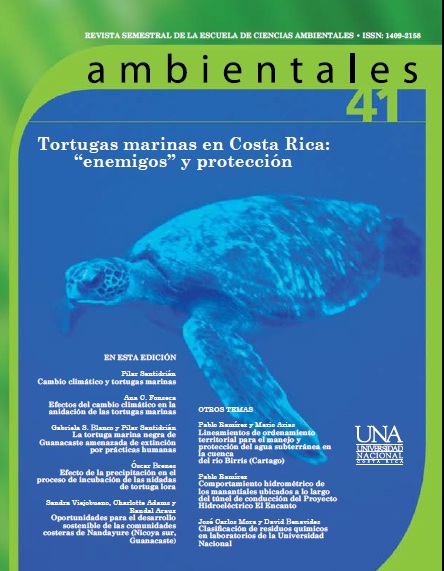
Climate Change and Sea Turtles
DOI:
https://doi.org/10.15359/rca.41-1.1Keywords:
Marine turtles, temperature, climate change, mitigation, sea levelAbstract
Climate changed has become one of the main threats to biodiversity and biological processes. High temperatures negatively affect several aspects of the life history of marine turtles both on nesting beaches and in the ocean. Increasing temperatures, caused by climate change, can be highly detrimental to sea turtle populations. There are possible mitigation strategies that can be used to avoid local extinctions such as irrigation, shading and clutch relocation. However, it is important to use them correctly and specifically for each population once these become negatively affected by climate change.
References
Chan, E. H. y Liew, H. C. (1995). Incubation temperatures and sex-ratios in the Malaysian leatherback turtle, Dermochelys coriacea. Biological Conservation (74). http://dx.doi.org/10.1016/0006-3207(95)00027-2
Collins, M. et al. (2010). The impact of global warming on the tropical Pacific Ocean and El Ni-o. Nature Geoscience (3). http://dx.doi.org/10.1038/ngeo868
Fish, M. R. et al. (2005). Predicting the impact of sea-level rise on Caribbean sea turtle nesting habitat. Conservation Biology (19). http://dx.doi.org/10.1111/j.1523-1739.2005.00146.x
Harley, C. D. G. et al. (2006). The impacts of climate change in coastal marine systems. Ecology Letters (9). http://dx.doi.org/10.1111/j.1461-0248.2005.00871.x
IPCC. (2007). Cuarto informe de evaluación del Grupo Intergubernamental de Expertos sobre el Cambio Climático.
Morreale, S. J. et al. (1982). Temperature dependent sex determination: current practices threaten conservation of sea turtles. Science (216). http://dx.doi.org/10.1126/science.7079758
Reina, R. D. et al. (1982). Changed reproductive schedule of eastern Pacific leatherback turtles Dermochelys coriacea following the 1997-98 El Ni-o to La Ni-a transition. Endangered Species Research (7).
Saba, V. S. et al. (2007). The effect of the El Ni-o southern oscillation on the reproductive frequency of eastern Pacific leatherback turtles. Journal of Applied Ecology (44). http://dx.doi.org/10.1111/j.1365-2664.2007.01276.x
Santidrián Tomillo, P. et al. (2009). Influence of emergence success on the annual reproductive output of leatherback. http://dx.doi.org/10.1007/s00227-009-1234-x
Segura, L. N. y Cajade, R. (2010). The effects of sand temperature on pre-emergent green sea turtle hatchlings. Herpetological Conservation and Biology (5).
Sieg, A. E. (2010). Physiological constraints on the ecology of activity-limited ectotherms. (Tesis de doctorado). Universidad Drexel, Estados Unidos.
Solow, A. R., Bjorndal K. A, y Bolten A. B. (2002). Annual variation in nesting numbers of marine turtles. http://dx.doi.org/10.1046/j.1461-0248.2002.00374.x
Thomas, C. D. et al. (2004). Extinction risk from climate change. Nature (427). http://dx.doi.org/10.1038/nature02121
Valverde, R. A. et al. (2010). Field lethal incubation temperature of olive ridley sea turtle Lepidochelys olivacea at a mass nesting rookery. Endangered Species Research (12). http://dx.doi.org/10.3354/esr00296
Walther, G. R. et al. (2012). Ecological responses to recent climate change. Nature (416).
Weishampel, J. F., Bagley, D. A. y Ehrhart, L.M. (2004). Earlier nesting by loggerhead sea turtles following sea surface warming. Global Change Biology (10). http://dx.doi.org/10.1111/j.1529-8817.2003.00817.x
Wyneken, J. et al. (1988). Egg failure in natural and relocated sea turtle nests. Journal of Herpetology (22). http://dx.doi.org/10.2307/1564360
Downloads
Published
Issue
Section
License

This work is licensed under a Creative Commons Attribution-NonCommercial-ShareAlike 4.0 International License.