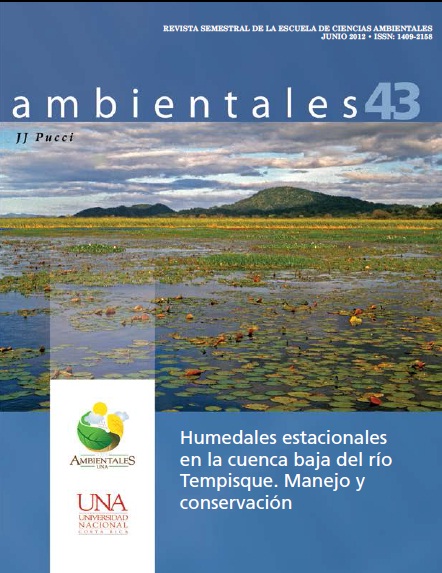
Management of Palo Verde Wetland and of its Bird Communities Associated to their Different Habitats
DOI:
https://doi.org/10.15359/rca.43-1.1Keywords:
Typha domingensis, wetlands, management, avian habitat use, Palo Verde, Costa Rica, seasonal dry tropical ccosystemsAbstract
Palo Verde National Park -Guanacaste, Costa Rica- is a RAMSAR Wetland of International Importance because it provides critical habitat for thousands of resident and migrating waterfowl and wading birds. Since the early 1980s, however, the park has been struggling to maintain bird habitat in the face of aggressive native cattail (Typha domingensis) expansion. This study examined the effect of cattail management, using a crushing technique called fangueo, on associated bird communities by comparing the area treated in January 2010 with two sites which had been treated in 2006, one of which has a diversity of habitats while the other is dominated by cattail. This study found that bird communities in cattail-dominated sites have lower diversity (Shannon diversity index) than those at other sites, but the bird community found in cattail sites is very different from the bird community found in hemi-marsh sites, emphasizing the importance of maintaining a mosaic of habitats within the marsh. Furthermore, a site last treated in 2006 was able to support a bird community indistinguishable from that found in recently treated fangueo sites. This suggests that some areas of the marsh do not need to be treated with fangueo on a yearly or bi-yearly basis and thus recommends further study of variations within the marsh with the goal of promoting natural resistance to cattail dominance.
References
Boers, A., R. Veltman y J. Zedler. (2007). Typha×glauca dominance and extended hydroperiod constrain restoration of wetland diversity. Ecological Engineering, 29. http://dx.doi.org/10.1016/j.ecoleng.2006.04.011
Clarke, K. y Gorley, R. (2006). PRIMER v6: User Manual/Tutorial. PRIMER-E. Plymouth, MA, USA.
Clarke, K. y Warwick, R. (2001). Change in marine communities: an approach to statistical analysis and interpretation, 2nd edition, PRIMER-E. Plymouth, MA, USA.
Convención Ramsar sobre Humedales. (1998). Procedimiento de Orientación para la Gestión, sitio Ramsar Parque Nacional Palo Verde, Costa Rica. Misión Ramsar de Asesoramiento, Informe Nº 39. Gland, Suiza (pp. 27).
De Szalay, F. y Resh, V. (2000). Factors influencing macroinvertebrate colonization of seasonal wetlands: responses to emergent plant cover. Freshwater Biology, 45(3). http://dx.doi.org/10.1111/j.1365-2427.2000.00623.x
Ellison, A. (2004). Wetlands of Central America. Wetlands Ecology and Management, 12. http://dx.doi.org/10.1023/B:WETL.0000016809.95746.b1
Horn, S. y Kennedy, L. (2006). Pollen evidence of the prehistoric presence of cattail (Typha: Typhaceae) in Palo Verde National Park, Costa Rica. Brenesia, 66.
Kaminski, R. y Prince, H. (1981). Dabbling duck and aquatic macroinvertebrate responses to manipulated wetland habitat. Journal of Wildlife Management, 45. http://dx.doi.org/10.2307/3807868
McCoy, M. y Rodriguez, J. (1994). Cattail (Typha domingensis) eradication methods in the restoration of a tropical, seasonal, freshwater marsh. En Mitsch, W. (Ed.). Global wetlands: old world and new. Elsevier.
Moreno-Mateos, D., Pedrocchi, C. y Comín, F. (2008). Avian communities' preferences in recently created agricultural wetlands in irrigated landscapes of semi-arid areas. Biodiversity and Conservation, 18.
Murkin, H., Kaminski, R, y Titman, R. (1982). Responses by dabbling ducks and aquatic invertebrates to an experimentally manipulated cattail marsh. Canadian Journal of Zoology, 60.
http://dx.doi.org/10.1139/z82-299
Osland, M. (2009). Managing invasive plants during wetland restoration: the role of disturbance, plant strategies, and environmental filters, Dissertation. Presented to the Faculty of the Graduate School of Duke University. United States.
Osland M., González, E. y Richardson, C. (2001). Restoring diversity after cattail expansion: disturbance, resilience, and seasonality in a tropical dry wetland. Ecological Applications, 21(3).
R Development Core Team. (2011). R: A language and environment for statistical computing. R Foundation for Statistical Computing, Vienna, Austria.
Rendon, M., Green, A., Aguilera, E. y Almaraz, P. (2008). Status, distribution and long-term changes in the waterbird community wintering in Do-ana, south–west Spain. Biological Conservation, 141.
http://dx.doi.org/10.1016/j.biocon.2008.03.006
Trama, F., Rizo-Patrón, F. y Springer, M. (2009). Macroinvertebrados bentónicos del humedal de Palo Verde, Costa Rica. Revista de Biología Tropical, 57.
Trama, F. (2005). Manejo activo y restauración del Humedal Palo Verde : Cambios en las coberturas de vegetación y respuesta de las aves acuáticas. Tesis. Presentada al Instituto Internacional en Conservación y Manejo de Vida Silvestre de la Universidad Nacional. Costa Rica, 2005.
Trama, F., Rizo-Patrón, F., Kumar, A., González, E., Somma, D. y McCoy, M. (2009). Wetland cover types and plant community changes in response to cattail-control activities in the Palo Verde Marsh, Costa Rica. Ecological Restoration, 27(3). http://dx.doi.org/10.3368/er.27.3.278
Turner, A. y McCarty, J. (1997). Resource availability, breeding site selection, and reproductive success of red-winged blackbirds. Oecologia, 113. http://dx.doi.org/10.1007/s004420050362
Varnell C., Thawaba, S. y Solis, M. (2010). Typha domingenius—A potential tool for bioremediation of wetlands as relevant to environmental forensics: A case study from Palo Verde, Costa Rica. Environmental Forensics, 11. http://dx.doi.org/10.1080/15275920903558364
Downloads
Published
Issue
Section
License

This work is licensed under a Creative Commons Attribution-NonCommercial-ShareAlike 4.0 International License.