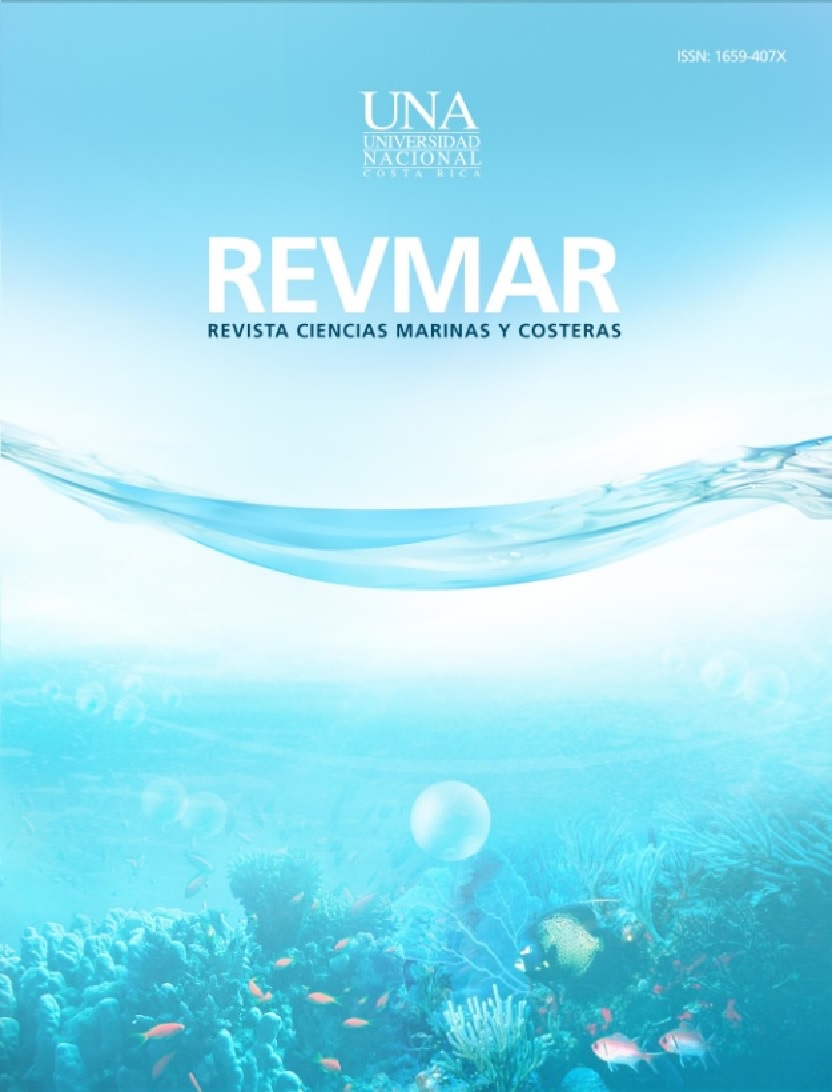
Capacidad antioxidante de los extractos hidroetanólicos de Thalassia testudinum y Syringodium filiforme para contrarrestar los efectos de la radiación UVB en la piel
DOI:
https://doi.org/10.15359/revmar.17-2-1Palabras clave:
Thalassia, Syringodium, radiação UVB, atividade antioxidante, SODResumen
La prevalencia de enfermedades de la piel relacionadas con la radiación solar ultravioleta (UV) ha aumentado de forma alarmante. La exposición directa a los rayos UV reduce los niveles de antioxidantes endógenos en la piel. El aumento acelerado de radicales libres puede activar procesos inflamatorios que dañan las fibras de colágeno y elastina, provocando un fotoenvejecimiento acelerado y la aparición de lesiones tipo melanoma a largo plazo. Sin embargo, la búsqueda de nuevos componentes y extractos naturales que puedan restaurar los niveles de antioxidantes endógenos mediante aplicaciones tópicas ofrece esperanzas de tratamientos efectivos. El trabajo tiene como objetivo evaluar la capacidad de los extractos obtenidos de las angiospermas marinas Thalassia testudinum y Syringodium filiforme de modificar los indicadores de estrés oxidativo en un modelo de fotodaño cutáneo inducido con luz UVB. Las hojas de ambas plantas se recolectaron en Rincón de Guanabo, Cuba, en noviembre de 2022. Ambos extractos presentan alto contenido de polifenoles (18 ± 1.5 y 25.78 ± 0.07 PyE%) y otros antioxidantes que inhiben la peroxidación lipídica con IC-50 menores 0.008 mg/mL. Los resultados demuestran además la capacidad antioxidante de ambos extractos para reestablecer los indicadores de estrés oxidativo: MDA, GSH y SOD hacia valores cercanos a los encontrados en pieles sanas no irradiadas. El extracto de T. testudinum presenta una mayor capacidad para aumentar los niveles de enzima SOD intracelular. La presente investigación sugiere que el tratamiento tópico podría contribuir a mantener los niveles de antioxidantes en la piel, reduciendo los efectos nocivos del desequilibrio oxidativo.
Referencias
Autier, P. & Doré, J. F. (2020). Ultraviolet radiation and cutaneous melanoma: a historical perspective. Melanoma Res., 30(2), 113-125. https://doi.org/10.1097/CMR.0000000000000609
Averill-Bates, D. A. (2023). The antioxidant glutathione. In G. Litwack (Ed.), Vitamins and hormones (pp. 109-141). Academic Press. https://doi.org/10.1016/bs.vh.2022.09.002
Ayala, A., Muñoz, M. F. & Argüelles, S. (2014). Lipid peroxidation: production, metabolism, and signaling mechanisms of malondialdehyde and 4‐hydroxy‐2‐nonenal. Oxid. Med. Cell. Longev., 2014(1), 360438. https://doi.org/10.1155/2014/360438
Batista‐Gonzalez, A. E., Silva, A., Vidal‐Novoa, A., Pinto, J. R., Mancini, D. A. P. & Mancini‐Filho, J. (2012). Analysis of in vitro and in vivo antioxidant properties of hydrophilic fractions from the seaweed Halimeda monile L. J. Food Biochem., 36(2), 189-197. https://doi.org/10.1111/j.1745-4514.2010.00525.x
Cheung, L. M. & Cheung, P. C. (2005). Mushroom extracts have antioxidant activity against lipid peroxidation. Food Chem., 89(3), 403-409. https://doi.org/10.1016/j.foodchem.2004.02.049
Cini, M., Fariello, R. G., Bianchetti, A. & Moretti, A. (1994). Studies on lipid peroxidation in the rat brain. Neurochem. Res., 19, 283-288. https://doi.org/10.1007/BF00971576
Fagundo-Mollineda, A., García, M. R., García, K. L. G., Iglesias, O. V., Rivera, Y. H., Alfonso, Á. R. C. & Martínez, O. V. (2016). Actividad fotoprotectora y fotorreparadora de los extractos de las angiospermas marinas, Thalassia testudinum Banks ex König (Hyrocharitacea) y Syringodium filiforme Kützing (Cymodoceaceae). Rev. Cienc. Mar. Cos., 8(1), 51-62. http://dx.doi.org/10.15359/revmar.8-1.4
Fagundo-Mollineda, A., Robledo, D., Vásquez-Elizondo, R. M. & Freile-Pelegrín, Y. (2023). Antioxidant activities in holopelagic Sargassum species from the Mexican Caribbean: Temporal changes and intra-thallus variation. Algal Res., 76, 103289. https://doi.org/10.1016/j.algal.2023.103289
Fallarero, A., Peltoketo, A., Loikkanen, J., Tammela, P., Vidal, A. & Vuorela, P. (2006). Effects of the aqueous extract of Bryothamnion triquetrum on chemical hypoxia and glycemia-induced damage in GT1-7 mouse hypothalamic immortalized cells. Phytomedicine, 13(4), 240-245. https://doi.org/10.1016/j.phymed.2003.10.009
Folin, O. & Ciocalteu, V. (1927). On tyrosine and tryptophane determinations in proteins. J. Biol. Chem, 73(2), 627-650. https://doi.org/10.1016/S0021-9258(18)84277-6
González, K. L., Rodríguez, M., Concepción, Á., Valdés, O., Marrero, J. G., Macías-Alonso, M., I., … & Gutiérrez, R. (2017). Phytochemical profile and evaluation of photoprotective potential of Syringodium filiforme kützing. Rev. Cien. Biol. Salud, 19(3), 18-22.
González, K. L., Valdés O., Laguna, A., Díaz M. & González, J. A. (2011). Efecto antioxidante y contenido polifenólico de Syringodium filiforme (Cymodoceaceae). Rev. Biol. Trop., 59 (1), 465-472.
Gupta, A., Singh, R. L. & Raghubir, R. (2002). Antioxidant status during cutaneous wound healing in immunocompromised rats. Mol. Cell. Biochem., 241, 1-7. https://doi.org/10.1023/A:1020804916733
Halliwell, B. (2008). Are polyphenols antioxidants or pro-oxidants? What do we learn from cell culture and in vivo studies?. Arch. Biochem. Biophys., 476(2), 107-112. https://doi.org/10.1016/j.abb.2008.01.028
Hawas, U. W. & Abou El-Kassem, L. T. (2017). Thalassiolin D: a new flavone O-glucoside Sulphate from the seagrass Thalassia hemprichii. Nat. Prod. Res., 31(20), 2369-2374. https://doi.org/10.1080/14786419.2017.1308367
Hernández-Balmaseda, I., Guerra, I. R., Declerck, K., Herrera Isidrón, J. A., Pérez-Novo, C., Van Camp, G., ... & Vanden Berghe, W. (2021). Marine seagrass extract of Thalassia testudinum suppresses colorectal tumor growth, motility and angiogenesis by autophagic stress and immunogenic cell death pathways. Mar. Drugs, 19(2), 52. https://doi.org/10.3390/md19020052
Hoang, H. T., Moon, J. Y. & Lee, Y. C. (2021). Natural antioxidants from plant extracts in skincare cosmetics: Recent applications, challenges and perspectives. Cosmetics, 8(4), 106. https://doi.org/10.3390/cosmetics8040106
Husein el Hadmed, H. & Castillo, R. F. (2016). Cosmeceuticals: peptides, proteins, and growth factors. J. Cosmet. Dermatol., 15(4), 514-519. https://doi.org/10.1111/jocd.12229
IBM Corp. (2020). IBM SPSS Statistics for Windows, Version 27.0. EE. UU.: IBM Corp.
Jafriati, J., Jumadi, O., Hatta, M., Natzir, R., Budu, B., Eddyman, W. F. & Sabir, M. (2019). Analysis of phythology components and potentials of antioxidant activities of Thalassia hemprichii extract. Int. Medical J., 24(3), 145-152.
Jesus, A., Mota, S., Torres, A., Cruz, M. T., Sousa, E., Almeida, I. F. & Cidade, H. (2023). Antioxidants in sunscreens: which and what for?. Antioxidants, 12(1), 138. https://doi.org/10.3390/antiox12010138
Kevrekidou, A., Assimopoulou, A. N., Trachana, V., Stagos, D. & Malea, P. (2024). Antioxidant activity, inhibition of intestinal cancer cell growth and polyphenolic compounds of the seagrass Posidonia oceanica’s extracts from living plants and beach casts. Mar. Drugs, 22(3), 130. https://doi.org/10.3390/md22030130
Lephart, E. D. (2016). Skin aging and oxidative stress: Equol’s anti-aging effects via biochemical and molecular mechanisms. Ageing Res. Rev., 31, 36-54. https://doi.org/10.1016/j.arr.2016.08.001
Lim, H. W., Kohli, I., Ruvolo, E., Kolbe, L. & Hamzavi, I. H. (2022). Impact of visible light on skin health: The role of antioxidants and free radical quenchers in skin protection. J. Am. Acad. Dermatol., 86(3), 27-37. https://doi.org/10.1016/j.jaad.2021.12.024
Lim, S. N., Cheung, P. C. K., Ooi, V. E. C. & Ang, P. O. (2002). Evaluation of antioxidative activity of extracts from a brown seaweed, Sargassum siliquastrum. J. Agric. Food Chem., 50(13), 3862-3866. https://doi.org/10.1021/jf020096b
Lucas, R. M., Yazar, S., Young, A. R., Norval, M., De Gruijl, F. R., Takizawa, Y. & Neale, R. E. (2019). Human health in relation to exposure to solar ultraviolet radiation under changing stratospheric ozone and climate. Photochem. Photobiol. Sci., 18(3), 641- 680. https://doi.org/10.1039/C8PP90060D
Marklund, S. & Marklund, G. (1974). Involvement of the superoxide anion radical in the autoxidation of pyrogallol and a convenient assay for superoxide dismutase. Eur. J. Biochem., 47(3), 469-474. https://doi.org/10.1111/j.1432-1033.1974.tb03714.x
Martínez-Daranas, B. & Suárez, A. M. (2018). An overview of Cuban seagrasses. Bull. Mar. Sci., 94(2), 269-282. https://doi.org/10.5343/bms.2017.1014
Mas-Bargues, C., Escriva, C., Dromant, M., Borras, C. & Vina, J. (2021). Lipid peroxidation as measured by chromatographic determination of malondialdehyde. Human plasma reference values in health and disease. Arch. Biochem. Biophys., 709, 108941. https://doi.org/10.1016/j.abb.2021.108941
McKenzie, R. L., Björn, L. O., Bais, A. & Ilyasd, M. (2003). Changes in biologically active ultraviolet radiation reaching the Earth's surface. Photochem. Photobiol. Sci., 2(1), 5-15. https://doi.org/10.1039/B211155C
Mitchell, C. L. (2016). Oxidative stress and the skin. In D. Armstrong & R. D. Stratton (Eds.), Oxidative Stress and Antioxidant Protection. (pp. 168-182). U.S.A.: John Wiley & Sons, Inc. https://doi.org/10.1002/9781118832431.ch11
Munteanu, I. G. & Apetrei, C. (2021). Analytical methods used in determining antioxidant activity: A review. Int. J. Mol. Sci., 22(7), 3380. https://doi.org/10.3390/ijms22073380
Newman, P. A., Nash, E. R., Kawa, S. R., Montzka, S. A. & Schauffler, S. M. (2006). When will the Antarctic ozone hole recover?. Geophys. Res. Lett., 33(12). https://doi.org/10.1029/2005GL025232
Ohkawa, H., Ohishi, N. & Yagi, K. (1979). Assay for lipid peroxides in animal tissues by thiobarbituric acid reaction. Anal. Biochem., 95(2), 351-358. https://doi.org/10.1016/0003-2697(79)90738-3
Owen, J. B. & Butterfield, D. A. (2010). Measurement of Oxidized/Reduced Glutathione Ratio. In P. Bross & N. Gregersen (Eds.), Protein Misfolding and Cellular Stress in Disease and Aging: Methods in Molecular Biology (pp. 269-277). U.S.A. Humana Press. https://doi.org/10.1007/978-1-60761-756-3_18
Parker, E. R. (2021). The influence of climate change on skin cancer incidence–a review of the evidence. Int. J. Womens Dermatol., 7(1), 17-27. https://doi.org/10.1016/j.ijwd.2020.07.003
Perry, M. J., Curic, M., Scott, A. L., Ritmejerytė, E., Rahayu, D. U., Keller, P. A., ... & Wangchuk, P. (2024). The In Vitro Antioxidant and Anti-Inflammatory Activities of Selected Australian Seagrasses. Life, 14(6), 710. https://doi.org/10.3390/life14060710
Phandee, S. & Buapet, P. (2018). Photosynthetic and antioxidant responses of the tropical intertidal seagrasses Halophila ovalis and Thalassia hemprichii to moderate and high irradiances. Bot. Mar., 61(3), 247-256. https://doi.org/10.1515/bot-2017-0084
Regalado, E. L., Menendez, R., Valdés, O., Morales, R. A., Laguna, A., Thomas, O. P. & Kijjoa, A. (2012). Phytochemical analysis and antioxidant capacity of BM-21, a bioactive extract rich in polyphenolic metabolites from the seagrass Thalassia testudinum. Nat. Prod. Commun., 7(1). https://doi.org/10.1177/1934578X1200700117
Regalado, E. L., Rodríguez, M., Menéndez, R., Concepción, Á. A., Nogueiras, C., Laguna, A. & Hernandez, Y. (2009). Repair of UVB-damaged skin by the antioxidant sulphated flavone glycoside thalassiolin B isolated from the marine plant Thalassia testudinum Banks ex König. Mar. Biotechnol., 11, 74-80. https://doi.org/10.1007/s10126-008-9123-8
Rivero, F., Fallarero, A., Castañeda, O., Dajas, F., Manta, E., Areces, F. & Vidal, A. (2003). Antioxidant activity in vivo and in vitro of Halimeda incrassata aqueous extracts. Food Sci. Technol., 23, 256-263. https://doi.org/10.1590/S0101-20612003000200026
Sen, C. K. (2003). The general case for redox control of wound repair. Wound Repair Regen, 11(6), 43-438. https://doi.org/10.1046/j.1524-475X.2003.11607.x
Sen, C. K. (2009). Wound healing essentials: let there be oxygen. Wound Repair Regen, 17(1), 1-18. https://doi.org/10.1111/j.1524-475X.2008.00436.x
Svobodová, A., Psotová, J. & Walterová, D. (2003). Natural phenolics in the prevention of UV-induced skin damage. A review. Biomed. Papers., 147(2), 137-145. https://doi.org/10.5507/bp.2003.019
Wuthirak, T., Kongnual, R. & Buapet, P. (2016). Desiccation tolerance and underlying mechanisms for the recovery of the photosynthetic efficiency in the tropical intertidal seagrasses Halophila ovalis and Thalassia hemprichii. Bot. Mar., 59(5), 387-396. https://doi.org/10.1515/bot-2016-0052
Zidorn, C. (2016). Secondary metabolites of seagrasses (Alismatales and Potamogetonales; Alismatidae): Chemical diversity, bioactivity, and ecological function. Phytochemistry, 124, 5-28. https://doi.org/10.1016/j.phytochem.2016.02.004
Zubia, M., Robledo, D. & Freile-Pelegrin, Y. (2007). Antioxidant activities in tropical marine macroalgae from the Yucatan Peninsula, Mexico. J. Appl. Phycol., 19, 449-458. https://doi.org/10.1007/s10811-006-9152-5
Publicado
Número
Sección
Licencia

Esta obra está bajo una licencia internacional Creative Commons Atribución-NoComercial-CompartirIgual 4.0.
Condiciones generales

Revista Ciencias Marinas y Costeras por Universidad Nacional se encuentra bajo una Licencia Creative Commons Atribución-NoComercial-SinDerivadas 3.0 Costa Rica.
La revista se aloja en repositorios de acceso abierto como el Repositorio Institucional de la Universidad Nacional, el Repositorio Kimuk de Costa Rica y la Referencia.
La fuente editorial de la revista debe reconocerse. Para ello utilice el identificador doi de la publicación.
Política de autoarchivo: La revista permite el auto archivo de los artículos en su versión arbitrada, editada y aprobada por el Consejo Editorial de la Revista para que sean disponibles en Acceso Abierto a través de Internet. Más información en el siguiente link: https://v2.sherpa.ac.uk/id/publication/28915






 Los artículos de la Revista Ciencias Marinas y Costeras se encuentra bajo la