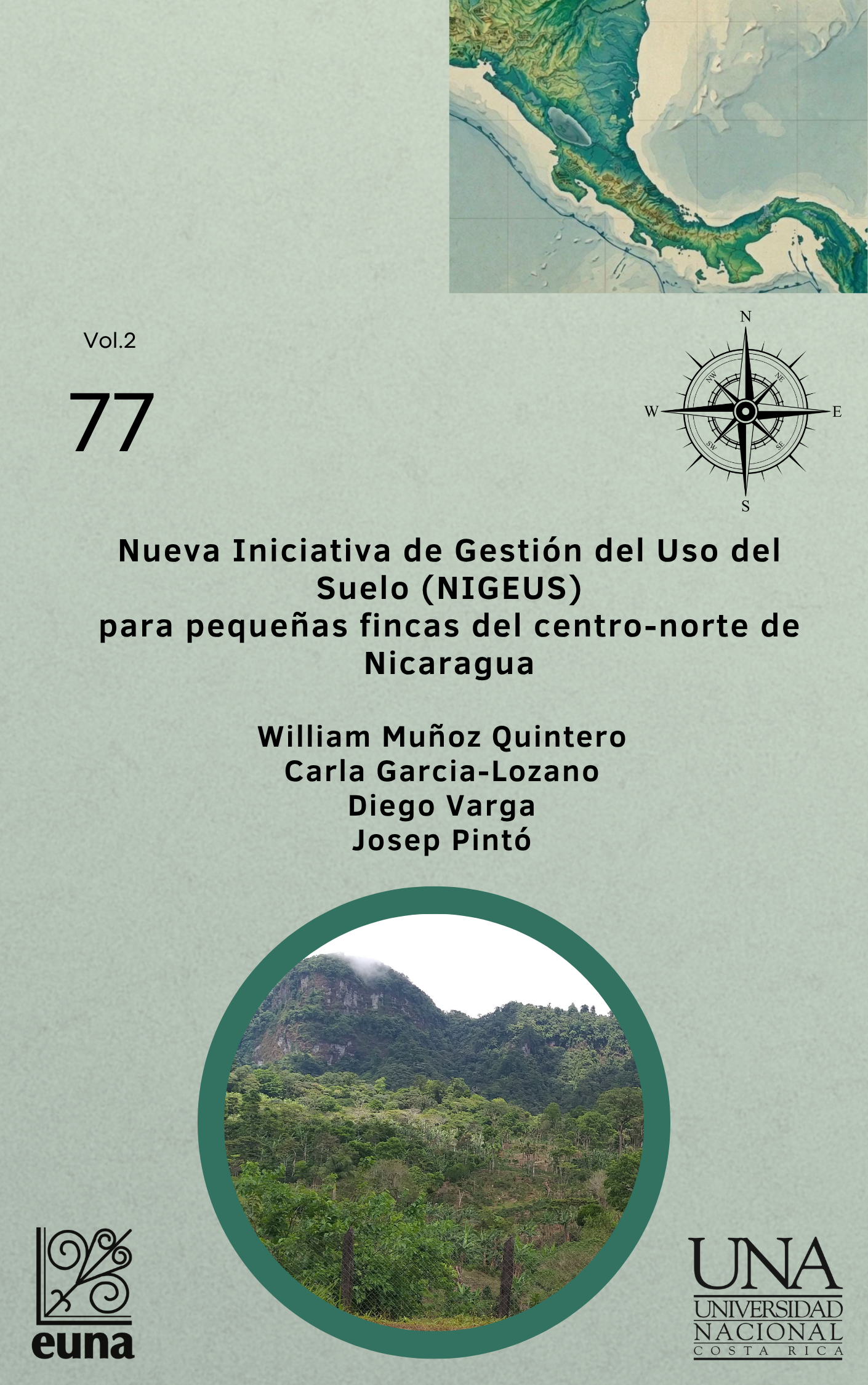
Nova Iniciativa de Gestão do Uso da Terra (NIGEUS) parapequenas explorações no centro-norte da Nicarágua
DOI:
https://doi.org/10.15359/Palavras-chave:
América latina, gestão de terras, pequenos agricultores, Princípios do MalawiResumo
Os pequenos agricultores da Nicarágua produzem mais de 80 % dos alimentos do país e enfrentam desafios que afetam o seu bem-estar económico e são vulneráveis aos riscos
climáticos e ambientais. Neste trabalho são analisadas oito Iniciativas de Gestão do Solo (IGEUS) e delas foram extraídos 25 indicadores-chave no desenho de um inquérito
que permitiu recolher informação sobre a gestão do solo em 455 explorações agrícolas localizadas nos municípios de El Tuma-La Dalia, El Cuá e Waslala, na Nicarágua, para os analisar numa perspetiva sustentável.
Os resultados revelam a necessidade de fortalecer as práticas baseadas em abordagens ecossistêmicas, integrais, holísticas, de igualdade de gênero e participativas. Uma nova
iniciativa para a utilização e gestão sustentável da terra (NIGEUS) emerge das nossas conclusões e a sua aplicabilidade dependerá de uma avaliação das partes interessadas.
Referências
Altieri, M. A. (2002). Agroecology: the science of natural resource management
for poor farmers in marginal environments. Agriculture, Ecosystems and Environment, 93, 1-24.
Berdegué, J. A., & Fuentealba, R. (2014). The State of Smallholders
in Agriculture in Latin America. New directions forsmallholder agriculture, 115-152. https://doi.org/10.1093/acprof:oso/9780199689347.003.0005
CBD. (1992). Convenio sobre la diversidad biológica naciones unidas1992, “Cumbre de la Tierra”. Río de Janeiro, Brasil, pp. 1-14.CBD. (1998). “Conference of the Parties to the Convention on Biological Diversity, Fourth Meeting Bratislava, Slovakia 4 to 15 May 1998.” English. pp. 1-15. https://www.cbd.int/deci sions/co p/?m=cop-04
Cherubin, M. R., Karlen, D. L., Franco, A. L. C., Cerri, C. E. P., Tormena,
C. A., & Cerri, C. C. (2016). A Soil Management Assessment Framework
(SMAF) Evaluation of Brazilian Sugarcane Expansion on
Soil Quality. Soil Science Society of America Journal, 80(1), 215-226. https://doi.org/10.2136/sssaj2015.09.0328
ECADERT. (2010). Estrategia Centroamericana de Desarrollo Rural Territorial
(ECADERT). Sistema de Integración Centroamericana (SICA). San José, Costa Rica. 1-120p.
FAO. (2014). Agricultura Familiar en América Latina y el Caribe: Recomendaciones de Política. www.fao.org/publications
FAO. (2015). World’ s Soil Resources. In Status of the World’s Soil Resources.
FAO-GEF. (2023). FAO, & GEF. (2023). 4ta Comunicación Nacional sobre
Cambio Climático. Managua, Nicaragua. 111-244p.
Faustino, J., & Jiménez, F. (2000). Manejo de Cuencas Hidrográficas (p.
35). https://repositorio.catie.ac.cr/bitstream/handle/11554/8431/Manejo_
de_cuencas_hidrograficas.pdf?sequence=1
Gumbi, N., Gumbi, L., & Twinomurinzi, H. (2023). Towards Sustainable
Digital Agriculture for Smallholder Farmers: A Systematic
Literature Review. Sustainability (Switzerland), 15(16). https://doi.org/10.3390/su151612530
Gutiérrez-Montes, I., Arguedas, M., Ramírez-Aguero, F., Mercado, L., &
Sellare, J. (2020). Contributing to the construction of a framework
for improved gender integration into climate-smart agriculture projects
monitoring and evaluation: MAP-Norway experience. Climatic Change, 158(1), 93-106. https://doi.org/10.1007/s10584-018-2231-1
Jordan, C. F. (2013). Holism vs. Reductionism in Environmental Science.
217-244. https://doi.org/10.1007/978-94-007-6790-4_8
Laurance, W. F., Sayer, J., & Cassman, K. G. (2014). Agricultural expansion
and its impacts on tropical nature. Trends in Ecology and Evolution,29(2), 107-116. https://doi.org/10.1016/j.tree.2013.12.001
López-Roldán, P., & Fachelli, S. (2015). Metodología De La Investigación
Social Cuantitativa. Metodología De La Investigación Social Cuantitativa,
4-41. http://ddd.uab.cat/record/129382
Lowder, S. K., Sánchez, M. V., & Bertini, R. (2021). Which farms feed the
world and has farmland become more concentrated? World Development,
142, 105455. https://doi.org/10.1016/j.worlddev.2021.105455
MARENA. (2010). IV Informe del Estado del Ambiente. Managua, Nicaragua,
pp. 199-225. https://www.marena.gob.ni/Enderedd/wp-content/
uploads/Docs/Documentos%20Tecnicos/Geo%20IV.pdf. (Consultada
12/02/2026).
MARENA. (2015). Estrategia Nacional de de Biodiversidad. Managua,
Nicaragua, pp. 1-56.
MARENA. (2020). Guía para el Manejo de la Biodiversidad. Managua,
Nic, pp. 1-34.
Muñoz, W., Garcia-Lozano, C., Varga, D., & Pintó, J. (2024). Analysis of
recent land management initiatives in Nicaragua from the perspective
of the “ecosystem approach.” Journal of Environmental Management,
354(February). https://doi.org/10.1016/j.jenvman.2024.120285
Nair, P. K. R., & Garrity, D. (2012). Agroforestry - The Future of Global
Land Use. Florida, U. S. A., pp. 217-247.
Orozco-Aguilar, L., López-Sampson, A., Leandro-Muñoz, M. E., Robiglio,
V., Reyes, M., Bordeaux, M., Sepúlveda, N., & Somarriba, E.
(2021). Elucidating Pathways and Discourses Linking Cocoa Cultivation
to Deforestation, Reforestation, and Tree Cover Change in
Nicaragua and Peru. Frontiers in Sustainable Food Systems, 5(June),
1-19. https://doi.org/10.3389/fsufs.2021.635779
PDT. (2014). Plan De Desarrollo Territorial Del Municipio De Waslala.
Waslala, Nicaragua, pp 1-94.
Pintó, J. (2010). Les unitats de paisatge. Eines i Instruments per a Les Polítiques
de Paisatge, February 2010, 83-106.
PNLCP. (2021). Plan Nacional de Lucha Contra la Pobreza. In PNLCP.
Managua, Nicaragua. 1-189 p.
Ravera, F., Tarrasón, D., siciliano, G. (2014). Rural change and multidimensional
analysis of farm’s vulnerability: A case study in a protected
area of semi-arid northern Nicaragua. Environment, Development
and Sustainability, 16(4), 873-901. https://doi.org/10.1007/
s10668-014-9531-z
Downloads
Arquivos adicionais
Publicado
Edição
Seção
Licença
Copyright (c) 2026 Carla García Lozano, Diego Varga, Josep Pintó, William Muñoz Quintero

Este trabalho está licenciado sob uma licença Creative Commons Attribution-NonCommercial-ShareAlike 4.0 International License.
Política proposta para revistas que oferecem Acesso Aberto
Os autores que publicam nesta revista concordam com os seguintes termos:
a. Os autores mantêm os direitos autorais e garantem à revista o direito de ser a primeira publicação do trabalho, sob a Licença Creative Commons https://creativecommons.org/licenses/by-nc-sa/4.0/deed.es, que permite que outros compartilhar com reconhecimento da autoria do trabalho e da publicação inicial nesta revista.
b. Os autores podem estabelecer separadamente acordos adicionais para a distribuição não exclusiva da versão do trabalho publicado na revista (por exemplo, colocá-la em repositório institucional ou publicá-la em livro), com reconhecimento de sua publicação inicial nesta revista. Esses acordos adicionais devem respeitar os termos da licença: ou seja: não envolver lucro e compartilhar com a mesma licença.
c. Os autores são incentivados a arquivar a versão/PDF pós-impressão ou do editor em repositórios de acesso aberto.


 REVGEO está licenciado sob https://creativecommons.org/licenses/by-nc-sa/4.0/deed.es
.svg_4.png)

_(1).png)
_(1)_(1)_(1)_1.png)
(2)(1)(1)(1).png)